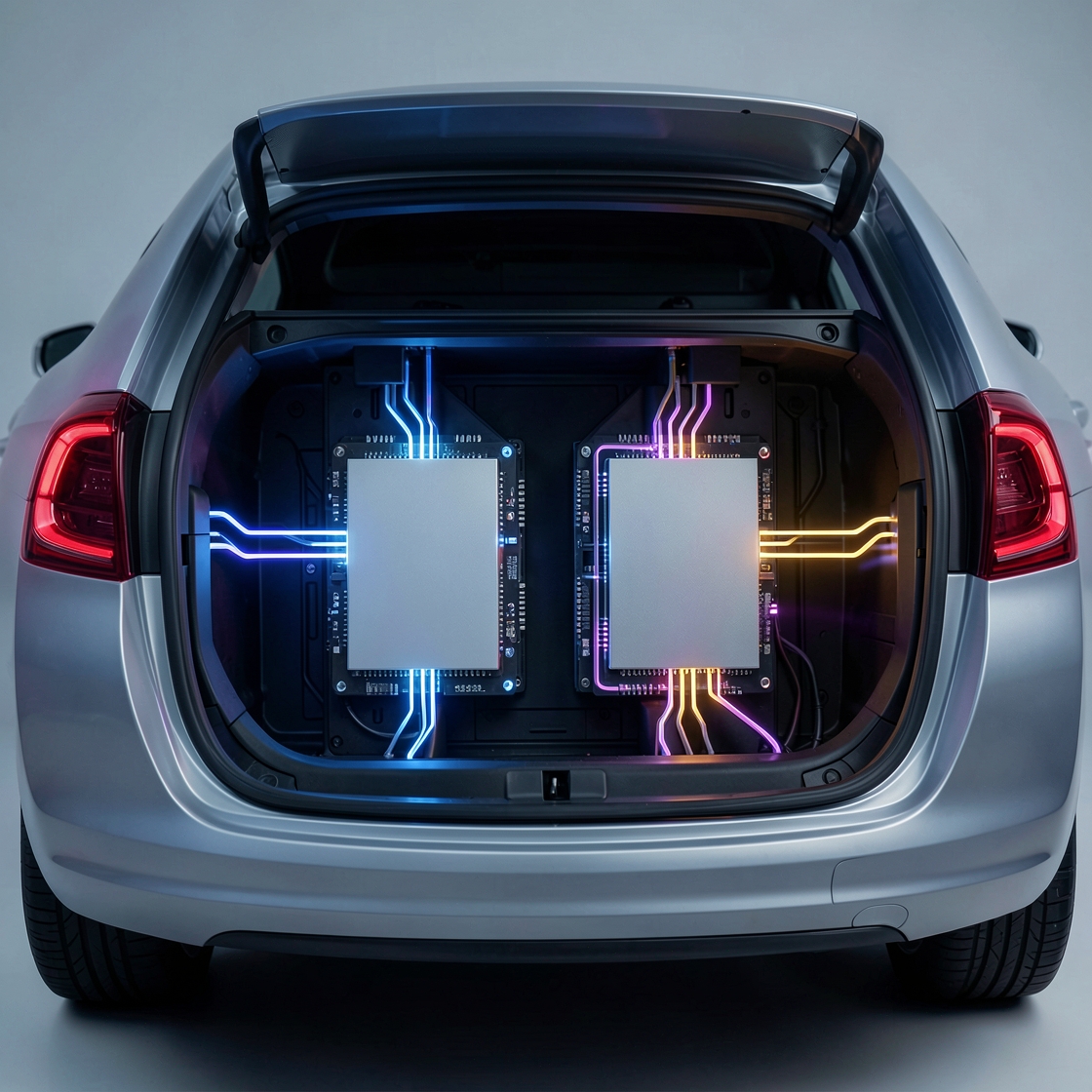
Waymo has disclosed new technical details about the computer that turns camera, lidar and radar data into driving commands inside its robotaxis. The centerpiece is a purpose-built 5-nanometer ASIC that the company says delivers more than 1,000 TOPS of machine-learning performance for front-end processing and models.
The original report by The Verge, published on August 20, 2026, described the system as the heavy compute “brain” carried in the vehicle. Waymo's technical announcement, published the same day, provides the primary specifications and explains why the company combines custom silicon with processors from established suppliers.
What the custom chip does
Waymo designed the 5nm application-specific integrated circuit, or ASIC, to sit near the front of the perception pipeline. It processes raw streams from lidar, radar and cameras, extracts useful information, fuses sensor inputs and runs neural networks before data reaches the rest of the vehicle's machine-learning system.
The company specifically identifies temporal denoising for low-light perception and support for different model types, from sparse convolutions to dense transformers. Its latest system can process feeds from 13 high-resolution cameras simultaneously and in real time, according to Waymo.
The stated figure of more than 1,000 TOPS means the ASIC can perform over one quadrillion operations per second for these machine-learning workloads. TOPS is a measure of computational throughput, however, not a direct measure of driving quality or safety. Real-world performance also depends on software, memory movement, latency, sensors, system integration and validation.
Waymo is not replacing every general-purpose component with its own silicon. The vehicle uses a heterogeneous architecture that combines its machine-learning technology with CPUs, GPUs and other accelerators for tasks such as orchestration, data movement and logging. The company named AMD, Micron, Nvidia, Samsung, SanDisk, Socionext and TSMC among its hardware partners, but did not map each supplier to a particular component in the announcement.
Why robotaxi compute differs from a data center
Cloud infrastructure helps train and test autonomous-driving models, but the immediate driving loop has to run inside the vehicle. Waymo says its onboard system continually turns sensor input into decisions within milliseconds, reducing the time from the first captured pixel to physical actuation. The company reports that its available compute power has increased twentyfold in eight years.
That processing also operates under constraints that a data-center server does not face. The computer must tolerate vibration, shock and large temperature swings, fit without consuming the entire luggage area and remain quiet enough for passengers. Waymo connects it to the vehicle's liquid-cooling system to sustain performance across different climates.
Redundancy is another core design requirement because there is no human fallback driver in a fully autonomous trip. Waymo describes two independent compute engines that normally run full workloads in parallel; if one develops a fault, the other is designed to take over. That architecture explains why peak throughput is only one part of the engineering problem: predictable latency and fault handling matter just as much.
How this fits the sixth-generation Waymo Driver
The disclosure adds detail to Waymo's broader shift toward co-designing sensors, compute and software. In its 2024 introduction of the sixth-generation Waymo Driver, the company described a sensor suite with 13 cameras, four lidar units, six radar units and external audio receivers. It said the new generation reduced component count and cost while retaining overlapping fields of view and safety-critical redundancy.
Waymo did not explicitly state in the new compute post which fleet vehicles contain the disclosed ASIC or provide a deployment schedule for the chip. The commercial context is nevertheless becoming more concrete: the company said in May that its purpose-built Ojai vehicle would be the first platform to debut the sixth-generation Driver for public riders. That Ojai update places the hardware program within a wider effort to support new vehicles and more varied weather conditions.
What matters beyond the headline number
The announcement shows a more vertically integrated approach to autonomous-driving hardware. A specialized front-end chip can be optimized around Waymo's exact sensor formats and model workloads, while standard CPUs, GPUs, memory and storage preserve access to a broader supplier ecosystem. Co-design can improve efficiency, but it also makes software, silicon and vehicle validation more tightly connected.
Important details remain undisclosed, including the complete system's power consumption, thermal envelope, unit cost, production volume and the achieved performance of its neural networks. Waymo has pointed readers to its Hot Chips presentations for more technical discussion. Those details will be more useful than TOPS alone for judging how the design balances latency, energy use, reliability and manufacturing scale.
For riders, the chip itself will remain invisible. Its significance is that autonomous-driving AI is increasingly an edge-computing problem: the vehicle must interpret a continuous stream of physical-world data, make time-sensitive decisions and continue operating through component faults without waiting for a cloud response.
Related Articles
VitVio's Vetro rollout in Gdańsk puts operating-room timelines first
The selected-room deployment targets surgical-stage logging and coordination. Its value depends on measured workflow results and clear handling of captured data.
Gemini 4 Argon opens wider, with different access rules for each product
The October 13 rollout brings Argon to paid API users and Gemini subscribers, but app access and coding access have different requirements.
OpenAI's Dublin Applied AI Lab will build with customers
The 200-job plan spans customer engineering, privacy, sales and operations. Its lab and Irish founder-training programme offer different forms of support.
Microsoft Maia 300 sets a 2027 date for inference at rack scale
Maia 200 is already in production. Maia 300's next-year rollout and rack-level claims call for a separate assessment of service access and workload performance.