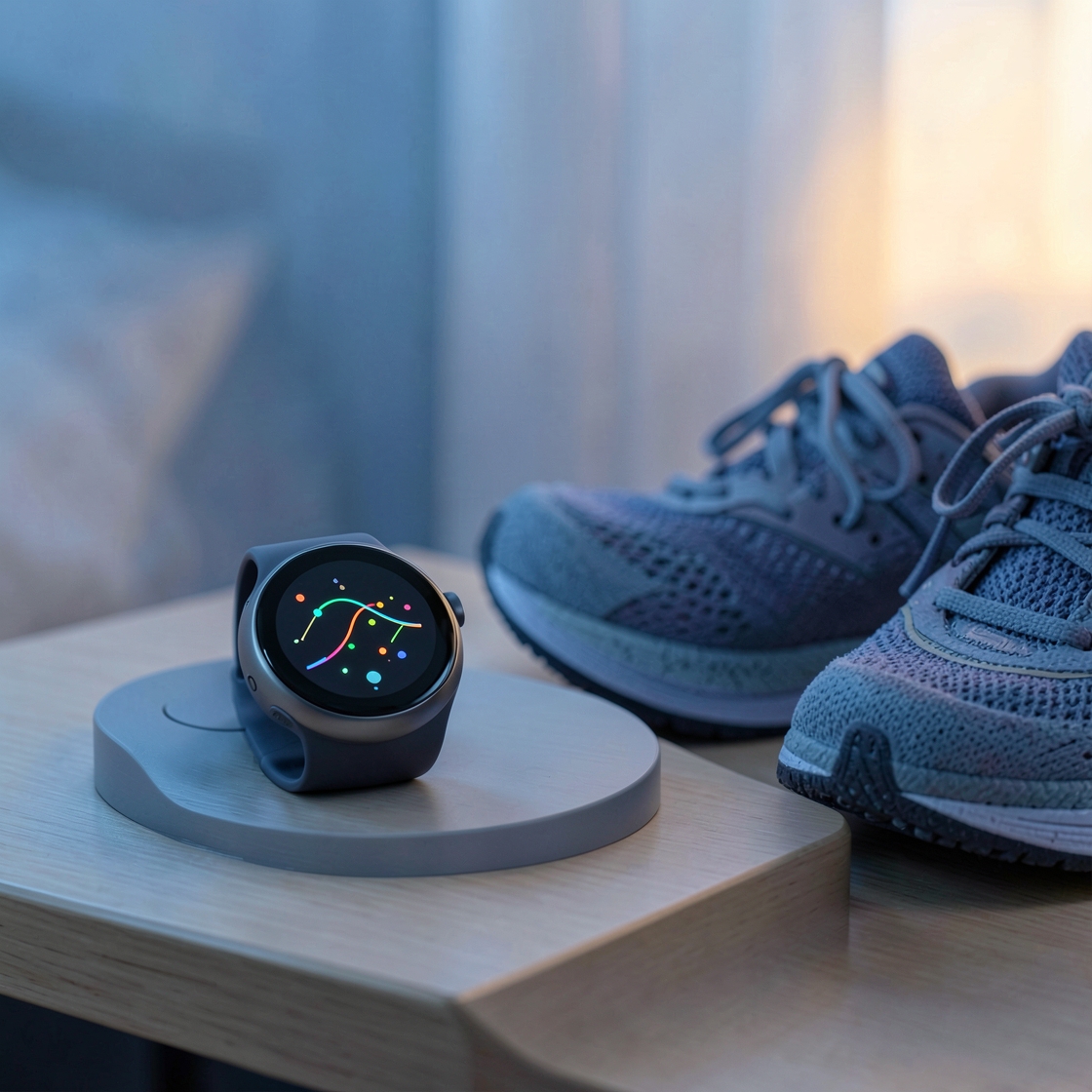
The Samsung Galaxy Watch9 wants to turn sleep, recovery and exercise into one continuous story. That ambition depends on wearing it overnight, building baselines and checking trends instead of reacting to one measurement. It also exposes the watch's central contradiction: the more complete the health story becomes, the harder it is to find a convenient time to recharge.
This is not a dramatic redesign of Galaxy Watch8. The familiar cushion-shaped case now carries a Snapdragon Wear Elite processor, larger batteries, a softer band and new health views. The practical question is whether those refinements make daily life clearer, or simply add more scores to a watch that still expects frequent charging.
This research-based review synthesizes Samsung's published specifications with independent tests by Android Central and Tom's Guide. TechKili did not wear, measure or test the watch. Battery, GPS, heart-rate, comfort and charging observations below remain attributed to the outlets and methods that produced them.
Galaxy Watch9 asks you to sleep in a watch that needs charging
Samsung's new Vitals view compares five overnight signals with a personal baseline: heart rate, heart-rate variability, breathing rate, skin temperature and blood oxygen. Fitness Index and Daily Cardio Load attempt a similar job for training. The value is context rather than a stream of isolated numbers, especially for people already keeping their sleep and workouts inside Samsung Health.
That context takes time. Samsung says Vitals needs seven nights to establish a baseline, while some other tools need calibration, supported regions or a compatible Galaxy phone. A reader should not buy the watch expecting every health card to become meaningful on the first morning. The strongest use case is patient trend tracking, not instant diagnosis, and Samsung explicitly frames these tools as wellness features.
The difficulty is continuity. Android Central's 44mm unit barely lasted through a full day in its routine, even with the always-on display disabled. Tom's Guide averaged about 32 hours from the 40mm model. Different sizes, settings and workloads prevent a direct contest, but both results leave the owner planning a charging window around overnight data.
The 40mm and 44mm choice changes the battery argument
Samsung sells 40mm and 44mm versions with Bluetooth or LTE. The smaller watch has a 390mAh battery; the larger one has 445mAh. Both use a sapphire-covered display rated up to 3,000 nits, dual-frequency L1+L5 GPS, 2GB of memory, 32GB of storage, 5 ATM water resistance and IP68 dust/water protection. The case is 8.6mm thick before the sensor housing and band are considered.
| Decision point | Galaxy Watch9 40mm | Galaxy Watch9 44mm | Practical effect |
|---|---|---|---|
| Battery capacity | 390mAh | 445mAh | Larger does not guarantee multi-day use |
| Samsung rated use | 30 hours | 40 hours | Plan around settings and workout load |
| Colors | Cream or Graphite | Silver or Graphite | Size also changes finish options |
| Connectivity | Bluetooth or LTE | Bluetooth or LTE | LTE adds independence but can increase drain |
| Core display/GPS | 3,000 nits; dual-frequency GPS | 3,000 nits; dual-frequency GPS | No need to size up for these features |
The 40mm model makes sense for smaller wrists and sleep comfort; the 44mm provides more battery capacity and screen area. Neither should be treated as an endurance watch. Tom's Guide measured roughly 90 minutes for a full 40mm recharge, while Android Central found the larger model also took well over an hour. A short shower may not be a long enough charging routine.
Vitals needs a week before it can become useful
Samsung's shift toward baselines is sensible. A resting heart rate or skin-temperature reading has more meaning when compared with the wearer's normal range. Vitals highlights deviations rather than pretending one number tells the whole story. Daily Cardio Load similarly uses recent activity and recovery context, while Fitness Index combines body composition, VO2 max, steps, heart rate and workout recovery.
The presentation can still overwhelm. Android Central found Fitness Index interesting but difficult to translate into a specific improvement. Tom's Guide liked the broader trend emphasis yet noted the growing number of dashboards. A single composite score can be easy to scan while hiding which input is noisy, missing or outside the user's control.
Access is another purchasing boundary. Blood-pressure functions require cuff calibration and periodic recalibration. Sleep-apnea detection, ECG and some AI insights depend on compatible devices, apps, accounts, age requirements and regional approval. Galaxy phone owners receive the deepest integration; buyers with another Android phone should verify each required feature rather than assuming Wear OS compatibility unlocks everything.
One accurate 5K does not settle the sensor question
Android Central recorded 3.15 miles from Galaxy Watch9 on an official 3.146-mile 5K route. In the same outlet's manual 5,000-step walk, Samsung counted 5,079 steps. Those are useful results, and the mapped route looked strong, but a later short run produced inconsistent heart-rate behavior compared with the other watches.
Tom's Guide found a different mixture during a 3.5-hour hike against Garmin Instinct 3. Galaxy Watch9's heart-rate data closely matched Garmin, but Samsung was less precise for distance, climb and pace and failed to log steps during that outing. Neither test invalidates the other; they show that route type, duration, movement and algorithm behavior matter.
One excellent route trace is evidence for that route, not permission to call every workout accurate.
For road runs and general activity, the dual-frequency hardware is encouraging. Hikers who rely on elevation, pace and long battery endurance should compare a dedicated outdoor watch. Anyone using health data to make medical decisions should use appropriate clinical equipment and professional guidance rather than a wellness score.
Snapdragon and Gemini improve moments, not the whole day
Galaxy Watch9 is Samsung's first standard watch with Snapdragon Wear Elite. Reviewers found performance responsive, and the faster platform helps app launches, workout starts and interface gestures feel immediate. Raise to Talk can open Gemini by lifting the wrist and speaking, removing a wake phrase or button press when the gesture works.
Tom's Guide considered Gemini one of the strongest smartwatch assistants it had tried. That matters for timers, messages, quick questions and supported app actions. Yet AI does not solve the battery schedule or organize every Samsung Health score into a plan. It improves small interactions throughout the day rather than changing the fundamental ownership rhythm.
The same distinction applies to comfort. Android Central praised the thin, light fit, and Samsung's softer air-pocket Sport Band helps the sensor sit close to the wrist. Comfort makes overnight data collection more plausible, but it cannot compensate for missing charge. Hardware and software are aligned around continuous wear; endurance remains the part that breaks the loop.
Watch8 owners should treat Watch9 as refinement
Galaxy Watch8 owners keep the same basic case sizes, 3,000-nit display, dual-frequency GPS and similar rated runtime. Watch9 adds the Qualcomm platform, battery capacity, a softer strap, Raise to Talk and selected health metrics. Those are worthwhile for a first-time buyer, but they do not make last year's watch obsolete.
Tom's Guide described the design, display and real-world battery as substantially unchanged. Existing owners should identify one specific friction before upgrading: slow performance, a worn band, a missing exclusive metric or a need for another support year. If no such problem exists, waiting is more rational than paying for a familiar daily experience.
New Galaxy-watch buyers face a different calculation. Watch9 offers Samsung's broadest standard-watch health interface without stepping up to the larger Ultra line. The 40mm size is especially relevant for smaller wrists, while the 44mm version favors readability. The absence of a Watch9 Classic means rotating-bezel fans should consider the retained Watch8 Classic rather than expect the standard model to replace it.
Choose Samsung, Google or Garmin by the missing feature
The best choice becomes clearer when framed around what each buyer refuses to lose:
Choose Galaxy Watch9 for Samsung phone integration, broad unpaywalled health context, a bright compact display and strong everyday apps.
Keep Galaxy Watch8 when its performance and battery already fit the routine; Watch9 is refinement, not a reset.
Choose a current Pixel Watch when Google's safety features, faster charging or a cleaner Google-first interface matter more than Samsung Health depth.
Choose Garmin Instinct 3 when multi-day endurance, outdoor navigation and consistent hiking metrics matter more than a rich smartwatch app ecosystem.
Galaxy Watch9 is easiest to recommend to a Samsung phone owner buying a first serious smartwatch. It is harder to recommend to a Watch8 owner or an endurance athlete. Its health context is genuinely more ambitious, comfort is a real strength and its GPS can be accurate, but the evidence does not support a universal accuracy or battery claim.
Buying options and alternatives
Affiliate disclosure: As an Amazon Associate I earn from qualifying purchases. Links in this section may earn TechKili a commission without changing the purchase price.
Samsung Galaxy Watch9 40mm Bluetooth Smartwatch (Graphite): The exact reviewed model in the 40mm Bluetooth Graphite configuration for buyers who want Samsung's newest standard Wear OS watch.
Google Pixel Watch 4 41mm Wi-Fi (Obsidian): A close Wear OS alternative with a cleaner Google-first experience and a different balance of health features, charging and battery behavior.
Samsung Galaxy Watch9 Sport Band, Yellow, S/M: An official compatible replacement band using Samsung's Dynamic Lug System, useful for a second workout-focused fit when the S/M size suits the wrist.

Sources, test disagreements and research limits
This synthesis keeps Samsung's specifications and wellness claims separate from independent observation. Android Central and Tom's Guide used different sizes, settings, routes and comparison devices, so their battery and fitness results should not be merged into one invented average. Prices and availability can change; no live Amazon price, stock, rating or product image is reproduced.
Sources: Samsung Galaxy Watch9 product page; Samsung overview of Watch9 changes; Samsung Japan release confirmation; Android Central Watch9 review; Tom's Guide month-long review; Tom's Guide hiking comparison; Android Central 5K and step comparison.