What the project achieved
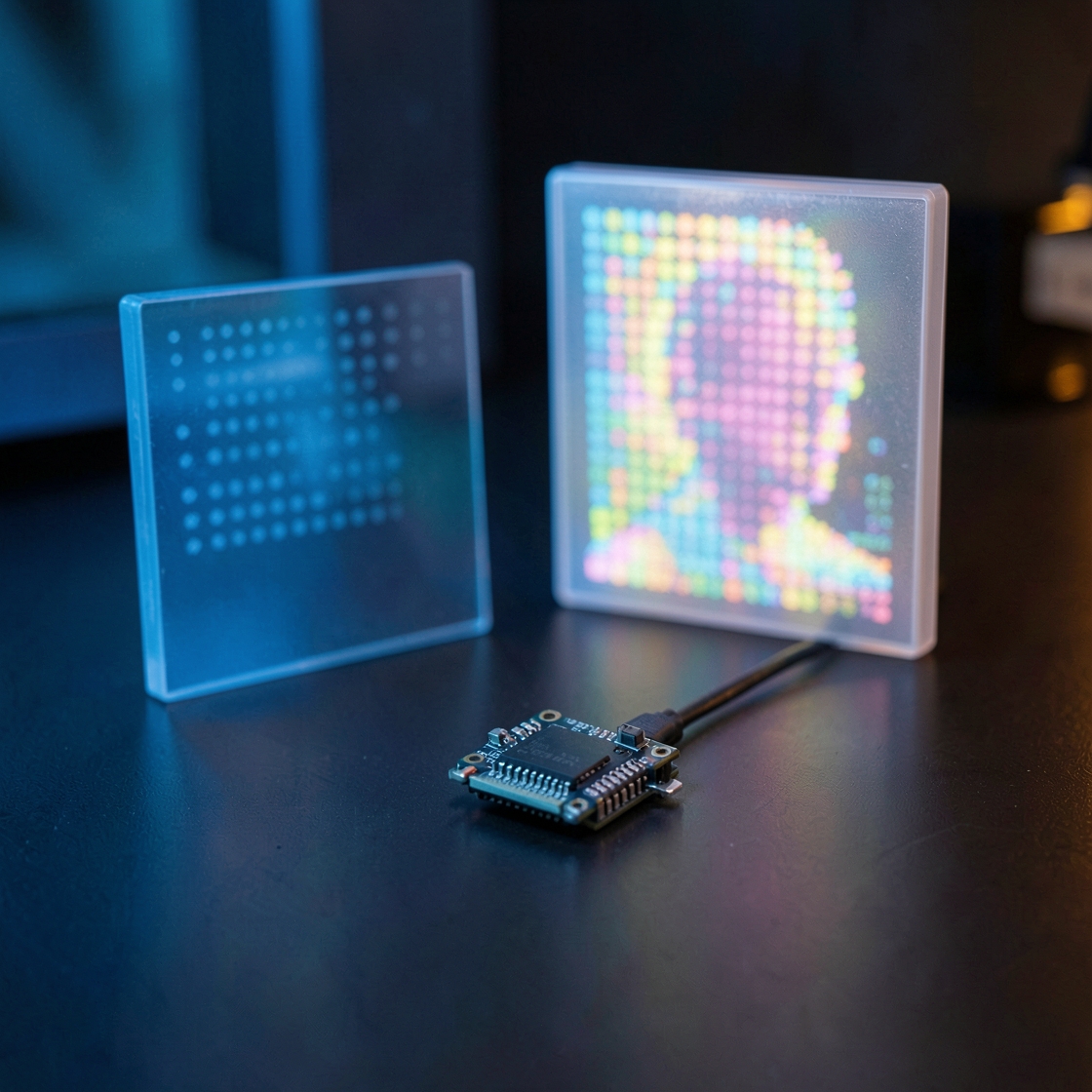
Hackaday reported on September 5, 2026 that developer Tim had made a generative image model run on an RP2350 microcontroller. The underlying project documentation says the complete model and inference code fit in less than 4 MB of flash and execute in 520 KB of RAM on the dual-core Cortex-M33 processor used by boards such as the Raspberry Pi Pico 2.
The result is deliberately narrow. It generates 128×128 RGB images of faces, supports five conditioning classes, and takes roughly 10 to 20 seconds per image depending on the model and settings. Images can be sent over USB or displayed through a VGA adapter. Those limits matter: this is a compact research and engineering demonstration, not a replacement for a general-purpose cloud image service.
How a diffusion model fits on a microcontroller
The system does not build the final image directly in pixel space. A variational autoencoder compresses each image into a 16×16×8 latent representation. A small diffusion transformer then moves that representation from noise toward a selected class over eight steps, and a decoder reconstructs the 128×128 output. Only the decoder is needed on the device.
Two model variants contain about 1.7 million and 2.9 million parameters. Their weights are quantized to 8-bit integers, while conditioning values and other fixed data are stored in lookup tables. The implementation streams weights from flash with DMA, processes the latent tokens in parallel and uses both Cortex-M33 cores. The developer also reports a roughly 15 percent inference gain from exploiting activation sparsity, although that measurement belongs to this implementation and should not be generalized to other models or hardware.
Why it matters for edge AI
The project is useful because it exposes the engineering trade-offs that disappear behind large hosted models. A small memory budget forces the model to narrow its output domain, reuse compact representations and move work from runtime computation into precomputed tables. The same principles can inform sensors, toys, industrial controls and other embedded systems where privacy, connectivity, power or predictable latency matter more than open-ended capability.
It also shows the boundary between training and inference. The model was trained off-device with much more powerful hardware; the RP2350 only runs the finished, quantized network. Local inference therefore reduces the data and connectivity needed during use, but it does not make model development itself inexpensive.
What developers should watch next
The author identifies quantization-aware training, a smaller conditioning design and further architecture tuning as possible improvements. Reproducing the result will also require the specific firmware and model assets from the public repository, plus an RP2350 board; the VGA hardware is optional because USB output is supported.
The broader lesson is practical rather than spectacular: useful generative behavior can fit on a microcontroller when the task is tightly scoped and the entire stack is designed around the hardware budget.