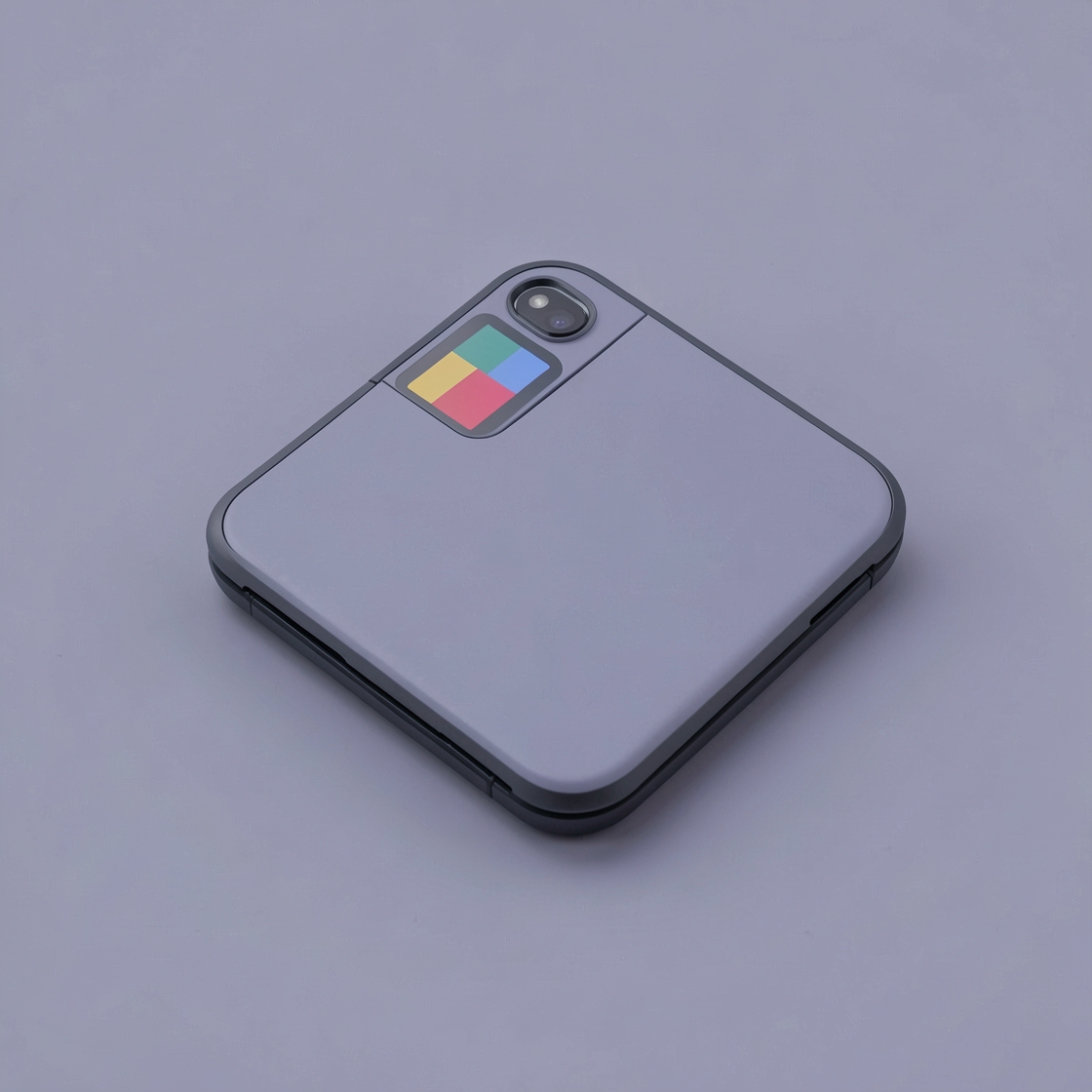
The Motorola Razr 2026 makes its best argument while it is closed. Its 3.6-inch outer display can answer a message, follow a delivery, change music or frame a photo without unfolding the 6.9-inch main screen. That is not merely a novelty: fewer openings can turn a flip mechanism into a deliberate interface for short tasks.
That useful workflow arrives in the least expensive model of Motorola's 2026 flip family, but “least expensive” does not mean cheap. The unlocked 256GB configuration launched at $799.99, $100 above its predecessor, while the MediaTek Dimensity 7450X still behaves like mid-range silicon. The buying decision is therefore about whether pocketability, battery life and cover-screen freedom outweigh speed and long-term durability anxiety.
This research-based review combines Motorola's specifications with testing by TechRadar, Android Central, PhoneArena and Tom's Guide. TechKili did not physically test the Razr 2026. Measurements, observations and endurance results are attributed to the outlets that produced them, and no current price or stock claim is made.
The smallest screen is the reason to buy this phone
Motorola lets ordinary apps run on the cover display instead of restricting it to a narrow widget set. Android Central found weather, music and notification replies especially natural there, while TechRadar called the screen genuinely usable across a broad range of apps. Chrome or a dense form can feel cramped, but quick interactions are precisely the point: a 3.6-inch window handles the interruption, then disappears into a pocket.
The inner panel remains a 6.9-inch, 120Hz foldable pOLED, so opening the device still produces a conventional large-phone canvas. The outer panel is rated at 90Hz and 1,700 nits, versus 3,000 nits for the main screen. Android Central found the smaller panel responsive but harder to read under direct sun. The design succeeds when the user treats the cover screen as a shortcut, not a substitute for every application.
A 188 g flip trades pocket space for hinge care
At 188g, the base Razr is the lightest member of Motorola's 2026 clamshell range. It folds to roughly 88.1 x 74 x 15.9mm and opens to 7.3mm thick. PhoneArena found the exterior almost unchanged from 2025, including the 3.6-inch screen and rounded frame, while noting a titanium-reinforced internal hinge intended to reduce micro-creasing.
IP48 protection is meaningful but limited. The “4” does not promise full dust sealing; it covers particles larger than 1mm under the standard's conditions. Android Central also warned that the curved outer glass can collect scratches, and Motorola's support page explicitly advises against third-party protectors on the folding inner display. A well-fitted exterior case is sensible, but replacing the factory inner film casually is not.
| Daily decision | Verified configuration | Buyer implication |
|---|---|---|
| Pocketability | 188g; 88.1mm tall when closed | Easier to carry than a full-height slab phone |
| Main display | 6.9-inch pOLED, 120Hz | Full-size workspace after unfolding |
| Cover display | 3.6-inch pOLED, 90Hz | Useful for replies, media and camera framing |
| Protection | IP48 and reinforced hinge | Water resistance, but not a dustproof or carefree device |
| Memory/storage | 8GB / 256GB in the reviewed US configuration | Ample storage; modest multitasking headroom |
| Update promise | Three Android upgrades and five years of security updates reported by reviewers | Shorter platform support than Samsung's close alternative |
The 4,800mAh battery changes the daily rhythm
Motorola fitted a 4,800mAh silicon-carbon battery without making the body thicker, 300mAh more than the Razr 2025. Tom's Guide recorded 14 hours 43 minutes in its web-browsing battery protocol and 71% charge after 30 minutes. TechRadar's two-week use regularly ended a 7am-to-11pm day with about 30–40% remaining, although heavy social scrolling or gaming still pushed the phone toward nightly charging.
Those results matter because older compact flip phones often demanded an endurance sacrifice. Here, using the cover display for short tasks can stretch the day further. Wired charging tops out at 30W and wireless charging at 15W; TechRadar gained 40% in 30 minutes in its test, which is useful rather than class-leading. A charger is not included, so buyers should confirm their existing USB-C power adapter supports the required profile.
Two 50MP cameras are more useful than their headline
The 50MP main and 50MP ultrawide cameras can use the closed phone's outer screen as a viewfinder. That lets the subject frame a selfie with the better rear sensors, while half-folding the phone creates a built-in stand for group shots or video calls. TechRadar considered the cameras competent rather than flagship, but the physical arrangement makes them more versatile than a simple megapixel comparison suggests.
PhoneArena judged the new ultrawide the biggest photographic upgrade over the 2025 model, citing a wider field of view, cleaner HDR and more pleasing color. It also saw improved portraits and detail, though there is no dedicated telephoto lens. Tom's Guide found the Ultra's low-light output clearly better; daylight differences among the 2026 models became less obvious without close inspection. Buyers should value flexible composition, not expect premium zoom.
Dimensity 7450X sets a clear performance ceiling
The 4nm Dimensity 7450X and 8GB of RAM handle messaging, maps, streaming and social apps, but they do not turn an $800 foldable into a flagship performer. TechRadar noticed short pauses when an app moved between the inner and outer screens. Android Central measured only marginal gains over the 2025 chipset and sometimes waited several seconds for the camera viewfinder when the phone became hot outdoors.
The two accounts differ mainly in severity. TechRadar considered the pauses acceptable for ordinary use; Android Central saw a risk of missing a photo. Both point to the same boundary: this model suits routine communication and media better than demanding games, sustained editing or rapid multitasking. Buyers paying for folding hardware must accept that part of the budget did not go toward top-tier silicon.
Buy the base Razr only when the cover-screen workflow and compact fold are worth more to you than flagship speed; a discount cannot change the processor ceiling, but it can make that tradeoff rational.
The real rivals are last year's Razr and a discounted Flip FE
The Razr 2025 shares the same dimensions and display sizes. The 2026 update brings the larger battery, 50MP ultrawide, slightly newer chip and reinforced hinge, yet TechRadar still found the overall experience very familiar. Owners of the 2025 phone should keep it unless battery capacity or ultrawide quality solves a specific problem. New buyers should compare actual prices: a steeply discounted predecessor may offer most of the same cover-screen value.
Samsung's Galaxy Z Flip7 FE offers a different compromise. Reviewers credit Samsung with seven years of software support, while Motorola's reported policy is three Android upgrades plus five years of security fixes. Motorola counters with larger displays, 256GB in the reviewed base configuration, freer cover-screen apps and stronger tested battery life. Motorola's Razr Ultra 2026 adds flagship performance, larger screens and better low-light photography, but its much higher launch price changes the audience entirely.
Buy the workflow, not the folding spectacle
The Razr 2026 is a considered purchase for people who repeatedly check a message, map, timer or camera and want those moments contained on a small outer screen. It is also attractive to buyers with genuinely small pockets who still want a large display when reading or watching video. Its battery removes one traditional flip-phone penalty, and the dual rear-camera selfie workflow is practically useful.
Use this ownership checklist before buying:
Compare the live price with the Razr 2025 and Galaxy Z Flip7 FE rather than assuming newest means best value.
Accept that IP48 is not full dust protection, and keep grit away from the hinge.
Do not install an unapproved protector on the folding inner display; follow Motorola's service guidance.
Choose a case designed for the base Razr 2026, not the Plus or Ultra dimensions.
Skip this model for heavy gaming, fast camera launch under heat, telephoto work or the longest update promise.
For the right person, the phone's restraint is its strength: close it, handle the small task, and put it away. For anyone who unfolds a phone for nearly every interaction, a conventional flagship supplies more performance and camera hardware for similar money. The fold needs to change behavior, not merely appearance.
Buying options and alternatives
Affiliate disclosure: As an Amazon Associate I earn from qualifying purchases. Links in this section may earn TechKili a commission without changing the purchase price.
Motorola Razr 2026 | Unlocked | Made for US 8/256GB | 50MP Camera | Bright White: The exact unlocked US Motorola Razr 2026 configuration reviewed here, with 8GB RAM and 256GB storage.
Samsung Galaxy Z Flip7 FE Cell Phone, 128GB AI Smartphone, White, Unlocked: A close flip-phone alternative for buyers who prioritize longer software support and Samsung's service ecosystem.
Cresee Case for Motorola Razr 2024/2025/2026, Green: A slim case whose opened listing explicitly names the base Motorola Razr 2026 as compatible; it protects the exterior without modifying the factory inner screen protector.

Sources, test boundaries and what remains unknown
Motorola supplies the display, processor, camera, battery, durability and availability claims. TechRadar contributes extended-use battery, charging, performance and camera observations; Android Central contributes benchmarks, heat behavior, software and durability notes; PhoneArena contributes predecessor camera comparisons; Tom's Guide contributes standardized battery and lineup results. Long-term hinge wear cannot be established from launch-period reviews.
Sources: Motorola product page; Motorola launch and availability; Motorola screen-protector guidance; TechRadar review; Android Central review; PhoneArena review; Tom's Guide lineup test.
Related Articles
USBSID-Pico connects vintage SID chips to USB, but the board revision matters
Hackaday's retrocomputing coverage highlights a bridge for real Commodore 64 sound chips. Voltage settings, controller choice and software support need a closer look.
Apple HomeView privacy depends on your paired device, too
A shared display's personal content requires face recognition and a recently unlocked paired device. Apple's Wi-Fi exception matters when setting household rules.
Harris HF-10 teardown shows how a clock tunes an analog filter
A newly identified 1985 chip links to the MF10 filter design. Its charge-transfer method explains clock-based tuning, while part identity alone cannot certify a replacement.
CMF Speaker S and M launch with USB-C audio and distinct stereo options
CMF's first speakers share wired audio and Auracast. Size, identical-model stereo pairing and conditional battery claims matter more than their removable panels.