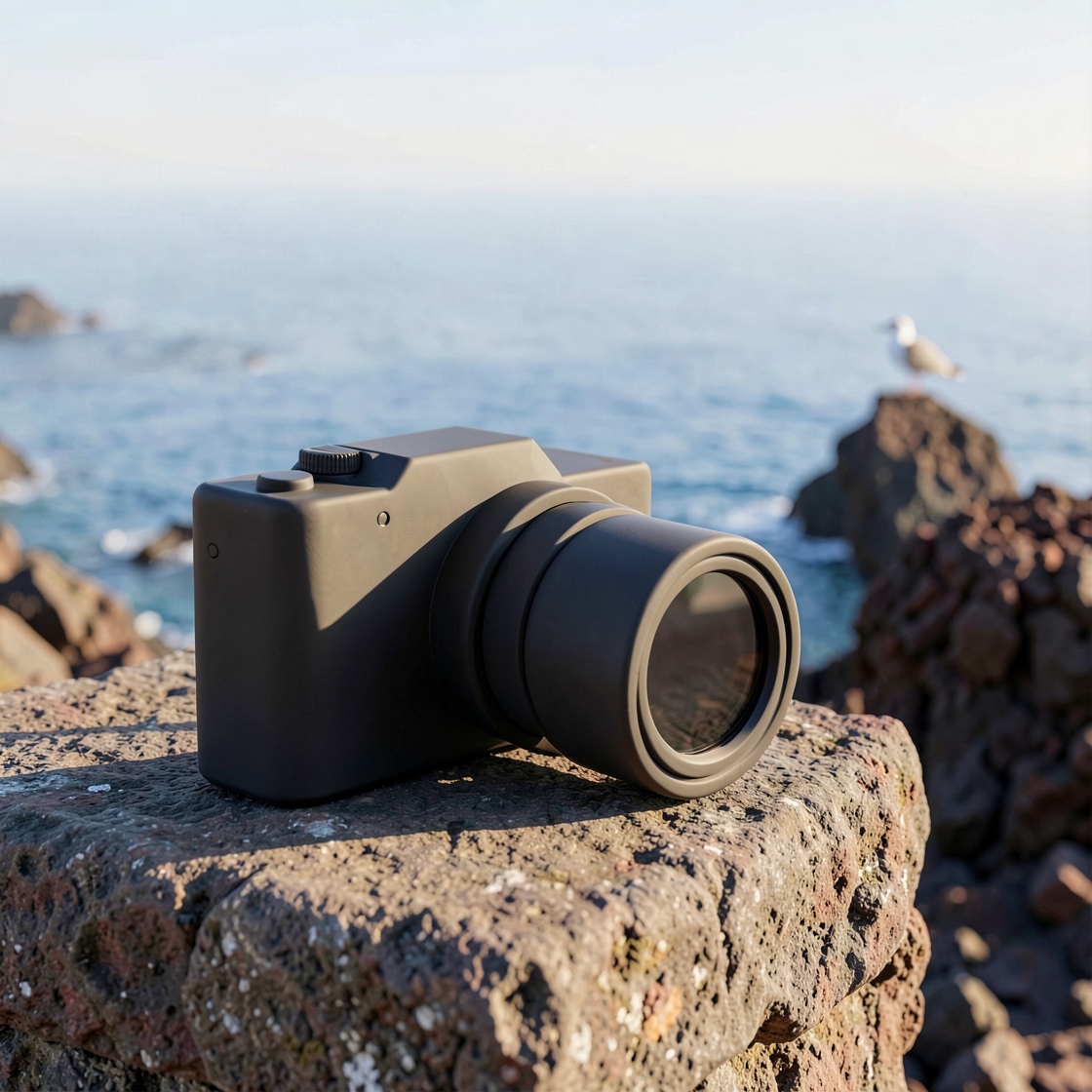
The Kodak PIXPRO AZ653 can put a bird, a distant stage or a mountain detail across most of the frame without changing lenses. That is its reason to exist. Its 65x optical zoom runs from a genuinely useful 24mm-equivalent wide angle to 1560mm, a range that would require several lenses and far more weight in an interchangeable-lens system.
Reach is not the same as a finished photograph. At the long end, a small movement becomes a large framing error, the lens is relatively dim, autofocus has less contrast to work with and atmospheric heat can erase detail before the sensor records it. The AZ653 is therefore best understood as an opportunity machine for patient daylight shooting, not a shortcut to professional wildlife results.
This research-based review synthesizes published specifications and independent testing. TechKili did not handle, photograph with or benchmark the camera. Findings about sharpness, focus, noise, handling and video remain attributed to the reviewers who produced them.
A 65x lens does not guarantee a distant photograph
The zoom number answers only one question: can the subject occupy enough pixels? It says nothing about whether those pixels will be sharp. Kodak pairs the range with optical stabilization and an electronic viewfinder, both essential when the field of view becomes narrow. TechRadar found the stabilizer effective and called the autofocus smooth, but also said it was not fast enough for the quickest animals. Slower wildlife and static landmarks are a better match.
Technique matters more as magnification rises. A fast shutter, support against a railing or tree, controlled breathing and a short burst can protect a frame from camera movement. Bright, even light helps the sensor and autofocus simultaneously. Heat haze over water or road can still make a correctly focused 1560mm image look soft; no stabilization system can remove moving air.
Treat 1560mm as a framing option, not a promise. Start wider, find the subject, zoom only as far as the light and focus allow, and take a second composition with more context.
The useful camera is hidden inside the zoom headline
The official AZ653 specification describes a 20.68MP 1/2.3-inch BSI CMOS sensor behind a 24-1560mm-equivalent f/2.9-6.7 lens. It records JPEG, RAW or both, offers program, aperture-priority, shutter-priority and manual exposure, and reaches roughly 5fps at full resolution. That is enough control to teach exposure and preserve files for later editing.
The rest of the package is deliberately modest: a fixed 3-inch 460K-pixel LCD, an electronic viewfinder, 1080p video at 30fps, USB-C charging and Wi-Fi remote control. Kodak specifies full-size SD, SDHC and SDXC cards up to 1.5TB, Class 10 or better. The LB-070 battery is rated for about 400 CIPA shots, but screen use, Wi-Fi, repeated zooming and image review will change a real outing.
| Capability | What it enables | Boundary to remember |
|---|---|---|
| 24-1560mm-equivalent optical zoom | Landscape, portrait and distant subject with one lens | Long-end shake, atmosphere and slow focus still reduce detail |
| 20.68MP small sensor | Enough resolution for screens and moderate crops in good light | Limited low-light and highlight latitude |
| RAW + JPEG | Immediate sharing plus an editable original | RAW cannot recreate clipped detail or missed focus |
| EVF + optical stabilization | A steadier three-point hold in bright conditions | The rear LCD is fixed and low resolution |
| 5fps burst | A short sequence around a predictable moment | Not a deep, fast sports buffer |
| 1080p/30 video | Family clips and static travel records | No 4K and unreliable behaviour while zooming |
Daylight gives the small sensor room to work
TechRadar's multi-week AZ653 test produced sharp, detailed photographs in good light and praised the deep grip, logical controls and lens ring. Its reviewer shot JPEG and RAW through the ISO range and found RAW usable to around ISO 800 before grain became a major concern. Raising ISO at capture worked better than aggressively lifting an underexposed file later.
That does not make the sensor equivalent to APS-C or full frame. The same review saw strong colour noise, weaker detail after dark and reduced sharpness toward the longest focal lengths. A bright smartphone can process a nearby night scene more convincingly; the Kodak wins when optical reach matters and there is enough light to use it.
Digital Camera World's field review arrived at a similar daylight boundary. It liked the secure grip and RAW colour, yet found the 460K-pixel LCD too coarse for judging critical focus and the lens-ring zoom stiff and slow. That screen problem is practical: a file can appear acceptable during capture and reveal missed focus on a larger display.
Fast wildlife exposes three separate bottlenecks
The first bottleneck is zoom travel. Moving from 24mm to 1560mm takes time, especially with the lens ring. A fast subject may leave the frame while the camera crosses the range. The shutter-button zoom lever is faster, but beginning at a medium focal length and anticipating where the subject will appear is safer.
The second is focus. Lens & Shutter's real-world review reported hunting at full telephoto in weak light, particularly with small moving subjects. TechRadar likewise drew a line between slower distant animals and fast wildlife. Prefocusing on a perch or finish line can work; expecting the camera to discover and track an erratic bird against branches is unrealistic.
The third is the 5fps burst and write pause. Five frames per second sounds adequate until the buffer fills or focus is slightly behind. Use short, deliberate sequences rather than holding the shutter. For children, zoo animals, school sport and perched birds, that discipline can produce useful results. For birds in flight or competitive field sport, a camera with phase-detect autofocus and a deeper buffer protects more moments.
Video inherits the same weaknesses. Digital Camera World reported autofocus trouble and audio interruptions during zooming, while Lens & Shutter considered the motor reasonably quiet but still described 1080p footage as casual. That disagreement reinforces the conservative conclusion: record at a chosen focal length, avoid zooming during a take and use another device when sound or 4K detail matters.
AZ653 modernizes the cable and downgrades the view
The official AZ652 page shows how little the imaging core changed. The predecessor already had the 20.68MP sensor, 24-1560mm f/2.9-6.7 lens, RAW, 5fps burst, Wi-Fi, EVF and approximately 400-shot rating. The AZ653 adds convenient USB-C charging, trims a little weight and raises declared SDXC capacity.
The visible regression is the display. AZ652 used a 920K-pixel articulating screen; AZ653 has a fixed 460K-pixel panel. That matters for flowers near the ground, overhead crowds, self-recording and any angle where the photographer cannot put an eye behind the viewfinder. USB-C is welcome, but it does not compensate automatically for losing articulation.
Owners of a working AZ652 therefore have little reason to upgrade for image quality. New buyers should compare the cost and condition of the older model, while remembering that batteries, support and used-camera wear complicate that choice. The newer camera is the simpler purchase when USB-C and current retail support matter; the predecessor remains ergonomically more flexible.
Choose Kodak, Panasonic or Nikon by the missed shot
The close alternative is the Panasonic Lumix FZ80D. Digital Camera World's bridge-camera comparison lists a 20-1200mm-equivalent 60x lens, 10fps burst, 4K recording and a higher-resolution touch display. Panasonic's official manual anchors the exact model. It gives up some extreme telephoto reach but better protects video, interface and short-action priorities.
Nikon's official COOLPIX P950 specification extends to 2000mm equivalent and adds 4K, a 2.36-million-dot EVF and a 3.2-inch vari-angle screen. It also weighs about 1005g, far beyond the Kodak's 588g body. The P950 makes sense when a larger bag is acceptable and finding, following and reviewing a very distant subject matters more than lightness.
Choose around the frame you most fear losing:
Choose AZ653 when one-lens reach, RAW learning and a lighter body matter, and most subjects are slow or static in daylight.
Choose FZ80D when 4K, a wider 20mm view, faster burst and a better rear interface protect more of your work than the final 360mm of reach.
Choose P950 when 2000mm, a stronger viewfinder and an articulating screen justify nearly doubling the carried weight.
Keep AZ652 when its articulating screen works and USB-C is not worth replacing an almost identical imaging system.
Build a daylight-first kit and expectation
A sensible AZ653 kit is small: a full-size Class 10 SDXC card, a simple support or monopod, a lens cloth and a charged battery. The 128GB card researched for the buying section is compatible with Kodak's declared SDXC range, but speed claims beyond what the camera can use should not drive the purchase. Avoid relying on the tiny internal memory.
Set expectations before the outing. Use RAW+JPEG when learning, check the histogram rather than trusting the coarse screen, and shorten focal length when shutter speed or focus confidence collapses. Do not plan an entire once-in-a-lifetime wildlife trip around maximum zoom without first practising on local birds, aircraft or distant signs.
The AZ653 is a good fit for the photographer who wants access rather than perfection: the parent in the stands, the traveller who will not carry lenses, or the beginner curious about manual exposure. It is a poor fit for indoor sport, serious video, reliable birds-in-flight tracking or large prints from weak light. The best feature is not 65x alone; it is having many possible frames in one manageable camera and knowing when not to use the longest one.
Buying options and alternatives
Affiliate disclosure: As an Amazon Associate I earn from qualifying purchases. Links in this section may earn TechKili a commission without changing the purchase price.
KODAK PIXPRO AZ653 Astro Zoom, Black: The exact black AZ653 listing matches the reviewed 20MP, 65x optical-zoom bridge camera; confirm the base camera rather than an open-box bundle at checkout.
Panasonic LUMIX FZ80D (DC-FZ80D): A close bridge-camera alternative for buyers who would trade some telephoto reach for 4K recording, a wider 20mm view, faster burst and a higher-resolution touch display.
SanDisk Extreme PRO 128GB SDXC UHS-I Card: A full-size Class 10 UHS-I SDXC card within Kodak's declared card support, useful for keeping RAW and JPEG files off the camera's tiny internal memory.

Sources, shared tests and research boundaries
Product identity and specifications come from the official Kodak PIXPRO AZ653 page. Generational analysis uses the official AZ652 page. Competitor fields are limited to the opened Panasonic FZ80D manual, Nikon P950 page and the current Digital Camera World bridge-camera guide.
Independent observations come from TechRadar, Digital Camera World and Lens & Shutter. TechRadar and Digital Camera World published substantially overlapping work by the same reviewer, so their agreement is not treated as two fully independent lab replications. Firmware, light, subject distance and technique differ; long-term reliability and repeatable autofocus rates remain unmeasured here.