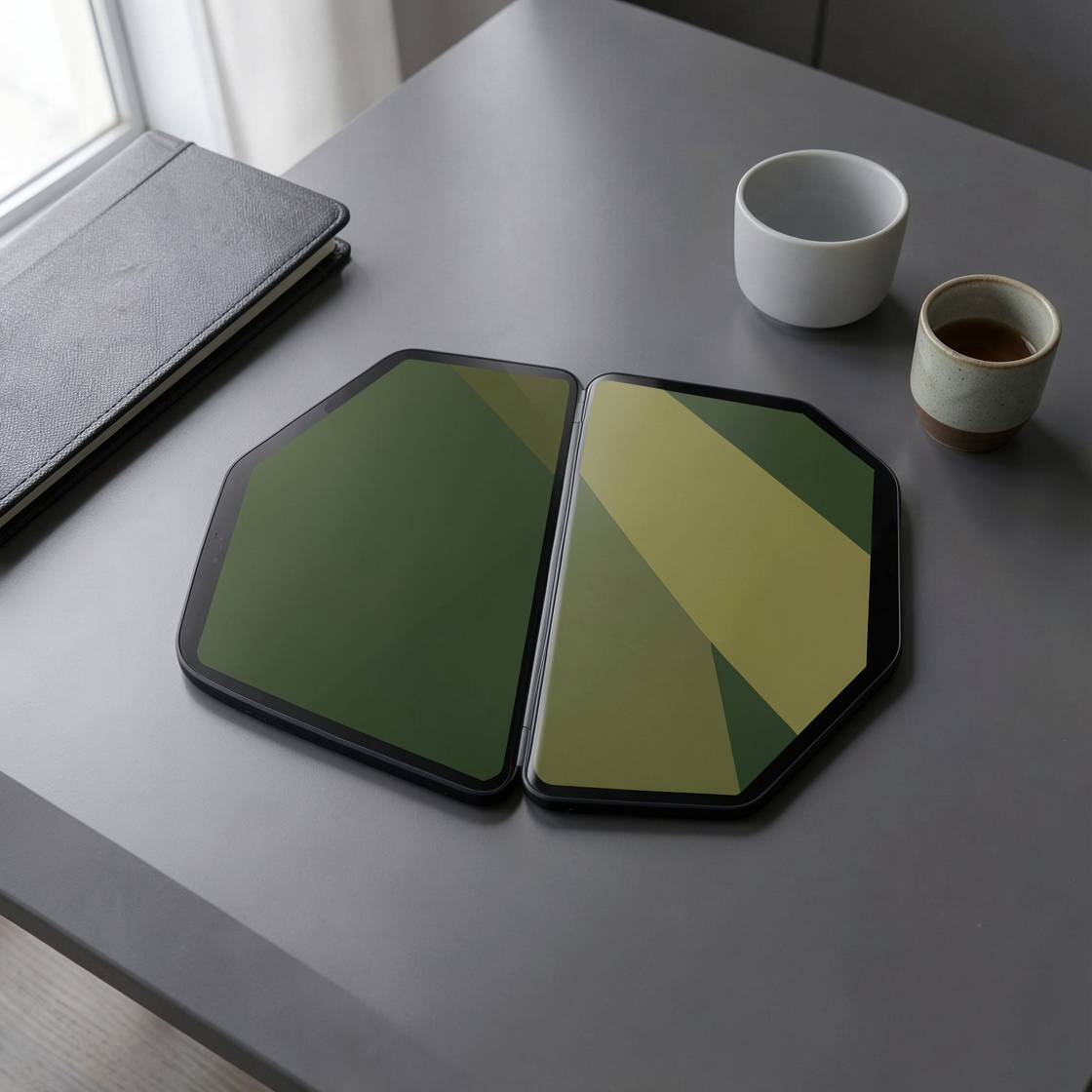
The Google Pixel 11 Pro Fold is easiest to understand when it is open. Closed, it is a capable but heavy Pixel phone. Opened, its 8-inch screen can hold a document beside a conversation, a map beside trip details, or a video beside notes. The purchase only works if that second mode becomes part of daily life rather than a demonstration shown to friends.
Google has improved the foldable in sensible places: it is lighter than its predecessor, the hinge is cleaner, both screens are brighter, wired and wireless charging are faster, and IP68 protection remains unusually reassuring for this category. Yet at 239 g and 10.1 mm folded, it still asks the owner to carry more hardware than Samsung's closest rival.
That produces a clear editorial conclusion. Pixel 11 Pro Fold is a strong Pixel workspace, but not the foldable that wins every hardware contest. Its software, 5x camera and built-in Qi2.2 charging are the reasons to buy; benchmark leadership, minimum weight and the most ambitious camera sensors are reasons to look elsewhere.
Quick take: buy the Pixel 11 Pro Fold for frequent two-app work and Pixel continuity—not simply because an 8-inch phone can fold into a pocket.
The point is the 8-inch Pixel workspace
Google's foldable tools make the inner panel more than a stretched phone screen. Split Screen and Drag and Drop support side-by-side work, bubbles keep a conversation floating over other apps, and dual-display camera modes let a subject see the frame. Those features can reduce switching when comparing information, answering messages or moving content between apps.
The value disappears when the phone is rarely unfolded. Its 6.5-inch cover display already handles ordinary messaging, photography and navigation well, so the extra cost and mass need a repeated large-screen task. A useful buying test is simple: identify three workflows that would benefit every week. If none comes to mind, a conventional Pixel offers most of the software experience in a lighter body.
A brighter fold that still carries its weight
Google lists a 6.5-inch outer OLED and an 8-inch folding OLED, both adaptive from 1 to 120 Hz and rated for up to 3,600 nits under specified conditions. Tom's Guide measured 2,982 nits on the inner display—below the manufacturer ceiling, but the highest foldable result in that publication's lab at the time. The two figures use different methods and should not be merged.
| Evidence | Verified result | What it means in use |
|---|---|---|
| Cover and inner displays | 6.5 and 8 inches, adaptive 1–120 Hz | Normal phone outside; useful two-app canvas inside |
| Independent inner-screen brightness | 2,982 nits in Tom's Guide's lab | Strong visibility is a genuine advantage, not only a launch claim |
| Folded dimensions | 10.1 mm and 239 g | Improved over Pixel 10 Pro Fold, still heavy for daily pocket use |
| Durability rating | IP68 when new, subject to Google's stated wear limitations | Better dust reassurance than many book-style foldables, not damage proof |
| Update commitment | Seven years of OS, security and Pixel Drop updates | Supports longer ownership if the hinge and battery age acceptably |
The hinge is a real refinement rather than a reinvention. TechRadar described smoother opening, a flatter inner panel and a less conspicuous crease. WIRED supplied the harder comparison: the Pixel remains heavier and thicker than Galaxy Z Fold8. Buyers should therefore test one-handed cover-screen use, trouser-pocket comfort and prolonged reading rather than judge ergonomics from open-display photos.
IP68 is meaningful because dust protection is still uncommon among book-style foldables. It is not a promise of permanent resistance: Google says water and dust protection can diminish through wear, repairs or damage. A premium foldable still benefits from cautious handling even when its rating is stronger than many rivals.
Tensor G6: smooth in use, behind in the lab
Tensor G6, 16 GB of RAM and Android 17 give the phone enough capacity for its intended multitasking. Tom's Guide measured Geekbench 6 scores of 2,687 single-core and 7,381 multi-core, plus 87.56 fps in 3DMark Wild Life Unlimited. Competing flagship foldables scored higher in that lab, while the same review described app launches, split-screen work and interface navigation as fluid.
That distinction matters more than declaring the processor simply fast or slow. Everyday buyers are unlikely to experience the benchmark gap while reading, editing documents or messaging. Sustained gaming, emulation and long-term performance headroom make the gap more relevant. Foldable software also remains imperfect: independent reviews encountered applications that did not always scale or transition cleanly between the two displays.
Google's AI and accessibility features add another boundary. Sign-to-text, proactive assistance and Gemini tools can be useful, but availability may depend on language, country, account or subscription. They should be valued only after confirming that the required feature works in the buyer's region; future capability is not the same as present utility.
Cameras favor reach over sensor ambition
The rear system pairs a 48 MP main camera with a 10.5 MP autofocus ultrawide and an optically stabilised 10.8 MP 5x telephoto. That optical reach is valuable on a foldable, and WIRED found the main and telephoto cameras capable of producing strong images. The same review called the ultrawide an obvious weak point because of grainier output.
Tom's Guide found little dramatic low-light improvement over Pixel 10 Pro Fold, while TechRadar appreciated the 5x lens but saw portrait cutout and colour inconsistencies in some scenes. The shared conclusion is not that the camera is poor: it is versatile and often good. The compromise is that Google's conventional Pixel 11 Pro phones use more ambitious camera hardware, so folding the screen means accepting a photographic step down.
Features such as rear-camera selfies, dual-screen preview, Camera Looks and Magic Capture use the form factor intelligently. They can improve framing or convenience, but software cannot create the missing sensor area of the ultrawide. Camera buyers should prioritise the useful 5x reach and flexible shooting positions rather than assume the “Pro” name guarantees Google's best imaging system.
A one-day battery with a better charging story
Google specifies a 4,806 mAh typical battery, 30 W wired charging and built-in Qi2.2 Pixelsnap charging up to 25 W. Tom's Guide recorded 12 hours 31 minutes in its repeatable drain test. WIRED lost 6% during an hour of video and 9% during an hour of casual gaming, reaching the end of an average day but needing battery saver after heavier photography and demanding games.
These are different workloads, yet they point in the same direction: reliable one-day endurance for moderate use, not a large reserve for intensive unfolded work. The inner display, camera, gaming and mobile data can all move the result. Buyers who expect tablet-like sessions should plan around charging access rather than extrapolate Google's “over 24 hours” claim to every workload.
Charging is the more distinctive improvement. Native magnetic alignment removes the case-and-ring workaround common on earlier Android phones, and 25 W wireless support can make a desk stand genuinely useful. It does not make wireless charging lossless or faster than every wired solution, but it integrates the foldable into a practical dock-and-use routine.
Pixel 10 Pro Fold and Galaxy Z Fold8 define the upgrade
Against Pixel 10 Pro Fold, the new model is nearly 10% lighter by Google's calculation, roughly 1 mm thinner, brighter and faster, with improved hinge behavior and charging. Tom's Guide measured only a 15-minute battery-test gain, and both its camera comparison and TechRadar's assessment describe modest rather than transformative progress. A one-generation owner should upgrade only for a specific new capability such as Pixelsnap or the revised fit.
Galaxy Z Fold8 sets the hardware-efficiency comparison. WIRED lists Samsung's model at 201 g and 9.7 mm folded, versus 239 g and 10.1 mm for Pixel. Pixel responds with IP68, 5x optical reach, integrated Qi2.2 and Google's software style. The choice is therefore not simply Android versus Android: Samsung better serves buyers prioritising low mass and raw performance, while Pixel better serves those invested in Google's interface, camera behavior and services.
A conventional Pixel 11 Pro or Pro XL is the third reference point. It gives up the 8-inch workspace but offers stronger camera hardware and less mechanical complexity. Anyone whose main reason for considering the Fold is “the best Pixel camera” should start with the non-folding Pro line instead.
Three buyers, three different answers
First-time Pixel foldable buyer: consider it when split-screen work, reading, maps or dual-display photography will be used repeatedly and the weight feels acceptable in person.
Pixel 10 Pro Fold owner: normally wait; upgrade only when Pixelsnap, reduced mass, brighter panels or a specific accessibility feature changes a real workflow.
Hardware-first foldable buyer: compare Galaxy Z Fold8 closely for lower weight and stronger benchmark performance, and verify which software ecosystem matters more.
The Pixel 11 Pro Fold earns its premium through continuity: it turns familiar Pixel software into a larger, more flexible workspace without abandoning dust protection, optical zoom or magnetic charging. It is less convincing as a specification trophy. The processor is not the category leader, the ultrawide is modest, and the body remains heavy.
The right decision is therefore task-based. If the phone will replace some tablet sessions and keep two applications visible, the compromises buy something tangible. If it will stay closed most of the day, the hinge becomes expensive luggage.
Buying options and alternatives
Affiliate disclosure: As an Amazon Associate I earn from qualifying purchases. Links in this section may earn TechKili a commission without changing the purchase price.
Google Pixelsnap Charger with Stand: A verified Qi2 charging stand that matches the Pixel 11 Pro Fold's built-in Pixelsnap charging capability; this listing is for the charger, not the phone.

Evidence, sources and research method
This is a research-based review synthesised from Google's published specifications and attributed independent testing. TechKili did not physically handle, photograph, benchmark, measure or use the Google Pixel 11 Pro Fold. Manufacturer claims, laboratory results and reviewer observations remain identified separately; current prices and promotions are excluded because they change by market and date.
Amazon research covered the exact phone, Galaxy Z Fold8 as a close alternative and a relevant charging companion. Only the Google Pixelsnap Charger with Stand listing could be opened and verified exactly. Its relevance follows from the phone's official Qi2.2 Pixelsnap specification; no Amazon product image, price, rating, stock claim or recommendation module is reused.
Sources consulted:
Related Articles
USBSID-Pico connects vintage SID chips to USB, but the board revision matters
Hackaday's retrocomputing coverage highlights a bridge for real Commodore 64 sound chips. Voltage settings, controller choice and software support need a closer look.
Apple HomeView privacy depends on your paired device, too
A shared display's personal content requires face recognition and a recently unlocked paired device. Apple's Wi-Fi exception matters when setting household rules.
Harris HF-10 teardown shows how a clock tunes an analog filter
A newly identified 1985 chip links to the MF10 filter design. Its charge-transfer method explains clock-based tuning, while part identity alone cannot certify a replacement.
CMF Speaker S and M launch with USB-C audio and distinct stereo options
CMF's first speakers share wired audio and Auracast. Size, identical-model stereo pairing and conditional battery claims matter more than their removable panels.