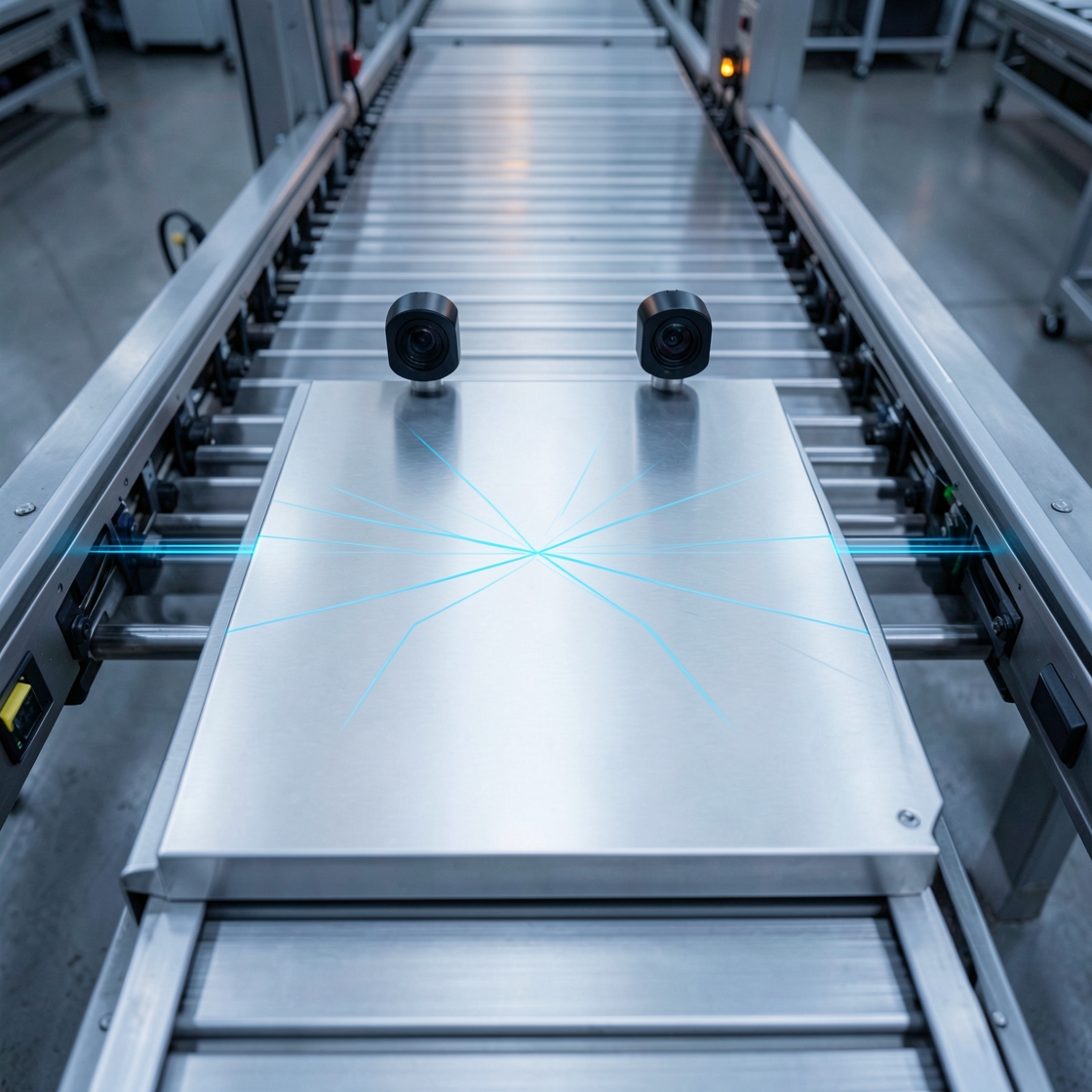
GE Appliances is combining computer vision, industrial sensors and centralized production data at its Roper Corporation cooking-appliance plant in LaFayette, Georgia. NPR reported the deployment on September 1, 2026 after visiting the factory and interviewing manufacturing leaders and workers.
AI is being used at specific decision points
Cameras along assembly lines are trained to flag anomalies such as an incorrect gasket. According to NPR's reporting, a detected problem can stop the affected part of the line so staff can investigate. The important boundary is that the model raises an exception; people still diagnose the cause and decide how to correct the process.
GE Appliances also collects machine and production data in a platform it calls Brilliant Factory. Manufacturing leaders told NPR that the system provides a view across nine major appliance plants, down to individual workstations. AI-generated reports highlight potential problems and possible responses, while sensor patterns such as a motor running unusually hot can prompt planned maintenance.
These are operational uses rather than a general-purpose chatbot placed on a factory floor. The inputs are images, equipment signals, scrap records, downtime and workflow data tied to concrete manufacturing tasks.
Why minutes matter in manufacturing
Bill Good, GE Appliances' vice president of manufacturing, told NPR that stopping one assembly line can cost the company between $300 and $500 per minute. He also estimated that each percentage point of operational improvement is worth $1.5 million to $2 million annually. Those figures are company estimates reported by NPR, not independently audited savings disclosed for this specific AI deployment.
The practical goal is to find defects earlier, reduce unplanned downtime and avoid scrapping material. A camera that catches a wrong component before the appliance advances can reduce rework. A maintenance alert can move a repair into a planned window. Whether the systems achieve those outcomes consistently requires measured false-positive rates, missed-defect rates and before-and-after operating data.
Automation is changing jobs as well as equipment
The Roper plant also uses autonomous vehicles and robotic assembly cells. GE Appliances' own economic-impact report describes a Robot Wrangler role responsible for keeping mobile robots operating and implementing systems that use camera vision and lidar. The company presents these changes as a way to move employees away from monotonous work and into higher-value tasks.
NPR's report says staffing optimization can move workers between tasks when demand changes. That is not evidence that automation has no labor impact. Useful evaluation should track which roles disappear, which are created, the training required and whether employees have realistic paths into the new work.
Investment provides the wider context
GE Appliances said in June 2025 that it had completed a $180 million expansion at Roper, including new equipment and products. Its 2024 Georgia economic-impact report also describes more automation and workforce training at the site. Those investments predate the current report and show that the AI tools sit inside a broader factory modernization program rather than operating in isolation.
The company attributes 600 added Georgia jobs to the expansion. That employment figure and the claim that AI helps domestic competitiveness come from GE Appliances and its executives. They establish the company's strategy, not a causal proof that AI alone created the jobs or secured production in the United States.
What to watch next
The strongest next evidence would include independently reviewable defect rates, downtime reductions, false alarms and the cost of maintaining models as products and lighting conditions change. Cybersecurity and access control also matter because centralized production data and connected equipment can expand the operational risk surface.
Workforce measures are equally important: training completion, job mobility, safety outcomes and how often staff override model recommendations. The real test is not whether a factory has AI, but whether the system produces measurable improvements while keeping accountable human control.