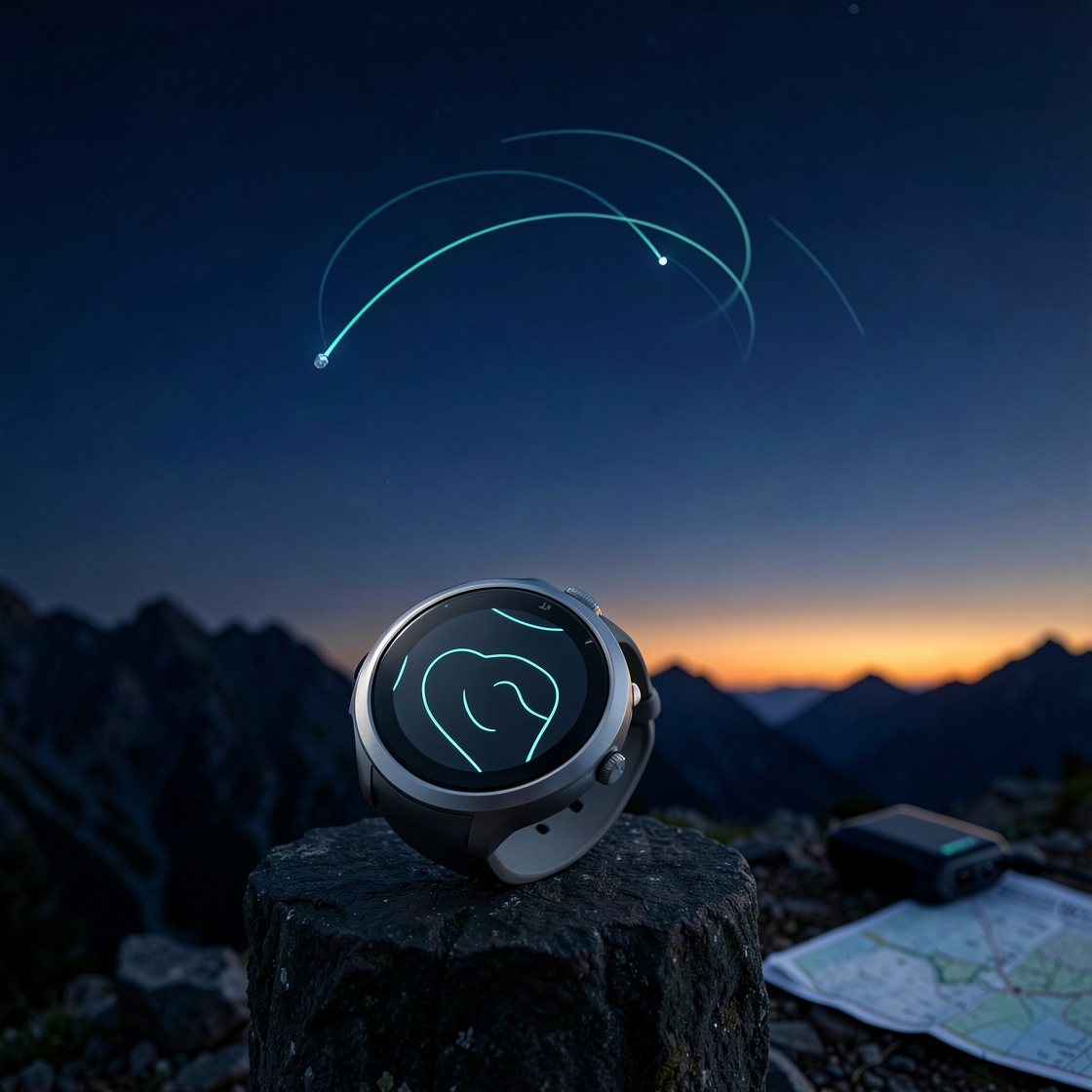
Garmin fēnix 9 Pro is easiest to misunderstand when it looks like a luxury materials upgrade. The full titanium case, brighter AMOLED display and slimmer proportions are welcome, but none explains why an outdoor athlete should pay for the Pro model. The decisive feature is the route home: LTE and satellite inReach messaging built into every case size, including the new 43mm option.
That route has conditions. It needs a paid plan, coverage where LTE is involved, a clear enough sky for satellite use and time to establish a link. Satellite mode carries messages and check-ins rather than voice calls or photographs. Continuous LTE tracking also spends battery quickly. This is a safety system to plan around, not a miniature phone that makes preparation unnecessary.
The rest of the watch is evolutionary. Garmin increases memory, doubles storage, brightens the screen and makes map interaction smoother while retaining a sensor platform close to fēnix 8 Pro. That combination can be excellent for a hiker moving from an older watch, yet weak value for an owner whose fēnix 8 already records every activity reliably.
This research-based review synthesizes Garmin documentation and independent field reports; TechKili did not wear, measure or benchmark the watch. Test results remain attributed to their publishers, and early battery evidence is not a substitute for months of use across every size and display.
Start with the escape route, not the titanium
The Pro suffix buys a communication path away from a phone. Garmin says users can send messages, check in, share LiveTrack and trigger SOS through LTE or satellite, depending on the feature and connection available. That matters to runners leaving a handset behind and to hikers traveling beyond mobile coverage. It matters much less to somebody who always carries a charged phone on well-covered routes.
Golem found Messenger calls over LTE reliable, though the voice sounded thin. Satellite was more constrained: text and check-ins worked, while calls, voice messages and photos did not cross that link. Connecting required the wearer to stop and maintain a suitable view of the sky. Those details define the actual product better than an emergency icon in a feature list.
Treat inReach as one layer in a route plan. Confirm the subscription, regional coverage, emergency contacts and sky-view procedure before a trip; do not discover those limits during an incident.
Thirteen configurations turn one watch into a planning exercise
The family spans three case sizes, two display approaches and base or Pro connectivity, with regional bundles creating more permutations. The 43mm AMOLED model answers a long-running fit problem. The 51mm versions maximize display and battery. Solar favors long outdoor use but gives up the color and brightness character of AMOLED. No single “best fēnix 9” exists without a wrist, route and charging plan.
| Choice | What changes | Practical reason to choose it | Cost paid elsewhere |
|---|---|---|---|
| 43mm AMOLED Pro | Smallest connected case, bright display | Small wrists and phone-free messaging | Least battery headroom |
| 47mm AMOLED Pro | Middle size, 1.4-inch display, balanced endurance | Mixed training and navigation | Still bulky for some wrists |
| 51mm AMOLED Pro | Largest AMOLED and up to 31 days smartwatch claim | Bigger map and longer trips | Weight and wrist footprint |
| Solar Pro | Sun-assisted endurance up to 57 days in the largest case | Long exposure outdoors and fewer charges | Less vivid display experience |
| Base fēnix 9 | Core maps, training, titanium and storage without inReach | Buyers who keep a phone nearby | No independent LTE/satellite path |
Garmin rates the AMOLED panel at up to 3,000 nits and says the 51mm display is 15% larger than fēnix 8. Storage rises to 64GB, enough for more maps and up to 7,000 songs under Garmin's estimate. Those are useful gains, but the table should be read from the constraint column: comfort, endurance and connectivity pull in different directions.
The map moves faster than the rest of the watch
Navigation is the clearest performance improvement. Garmin claims 50% more RAM and map panning up to 30% faster. TechRadar saw smoother maps and liked the perspective view. Golem's direct fēnix 8 Pro comparison also showed materially more fluid zooming and panning, an improvement that matters when a junction is approaching and gloves or rain make every extra gesture costly.
More memory does not remove every pause. Golem found ordinary menus only slightly faster and saw distant map tiles continue to load. The5KRunner's early checks reported mostly smooth menus, but also a 76-second cold start, occasional two-second shortcut delay and four-to-five-second activity saving. These observations do not negate the map gain; they keep “30% faster” from becoming “instant everywhere.”
The physical interface remains a strength. Touch helps when moving around a map, while buttons preserve predictable control during rain, swimming or winter use. TechRadar found the on-screen keyboard surprisingly accurate. Garmin Messenger, however, remained a separate and clunky app in that review, so the faster map is not matched by a perfectly unified communication workflow.
Small wrists pay for comfort with charging stops
TechRadar's 43mm review unit lost 17% during its first two-hour hike. The reviewer expected roughly weekly charging in normal mixed use and much more attention during a multi-day GPS trip. That is not a universal battery result, but it exposes the unavoidable exchange: a smaller watch has a smaller energy reserve even when its software matches the larger case.
Golem did not see an obvious mixed-use regression on the 47mm model. Its published specification table lists up to 18 days in smartwatch mode and 32 hours of GPS, while the 51mm version extends the ceiling. RunMorph nevertheless warned that comparable AMOLED GPS ratings sit below some preceding configurations. Different sizes, settings, firmware and test windows explain why one verdict cannot cover the range.
Connectivity changes the calculation again. Golem highlighted Garmin's 47mm estimate of 16 hours with continuous LTE LiveTrack versus 32 hours in ordinary GPS mode; the 51mm comparison is 27 versus 56 hours. A rescue-capable watch with an empty battery is not safer. Expedition buyers should budget using the mode they will actually run, not the largest smartwatch-mode number on the product page.
inReach is a safety system with boundaries
The useful distinction is between independence and universality. LTE can support richer communication where Garmin's service has coverage. Satellite supplies a narrower fallback beyond terrestrial networks. Neither guarantees immediate connection everywhere, and satellite does not turn the watch into a broadband communicator. Garmin's manual and service terms should be part of packing, alongside route files and a power plan.
LiveTrack can reassure contacts, while SOS escalation may connect the user to Garmin Response. But the wearer still has to know how to invoke it, communicate the situation and remain in a location where the device can see the sky. Dense cover, terrain, buildings and regional availability can intervene. Buyers should verify the service for their destinations before treating Pro as protective equipment.
The 43mm option is therefore more important than it sounds. Earlier connected flagships forced safety-minded buyers toward a larger case. Putting inReach into all three sizes broadens who can comfortably keep the device on overnight and throughout a trip. Comfort is part of safety because a watch left in a bag cannot measure, navigate or call for help.
Rowing and stamina improve; the sensor stack stands still
Garmin adds Stamina zones and a curve intended to show how effort is being spent, plus Garmin Epic for multi-day activities, rucking support and richer indoor rowing. TechRadar found Stamina Zones useful during intervals, although ten days was too short to verify every estimate. Golem successfully pulled Concept2 data into VO2 max, FTP, lactate and power-curve views, a meaningful integration for rowers who previously had fragmented metrics.
Those software gains should not be confused with new measurement hardware. TechRadar recorded virtually identical traces against fēnix 8 Pro in a same-run comparison. Golem likewise treated the sensor core as carried over. Sleep and recovery guidance aligned with TechRadar's condition, but one reviewer's agreement is supporting evidence, not clinical validation.
This is good news for consistency and bad news for upgrade urgency. A mature sensor platform can be preferable to novelty, and older models may receive some training functions through updates. Owners should identify one new workflow they will use — rowing integration, multi-day Epic planning, rucking or inReach in a smaller case — before paying for a generation number.
Keep fēnix 8, choose base 9, or pay for the rescue path
The base fēnix 9 keeps the titanium body, bright display, expanded storage, maps and core training platform. It is the rational choice when a phone accompanies every outing. fēnix 8 Pro remains compelling when already owned or discounted: its health sensing and inReach concept overlap heavily, while fēnix 9 Pro mainly improves ergonomics, storage and map fluidity.
Suunto Vertical 2 offers a 1.5-inch, 2,000-nit AMOLED display, offline maps and an official 65-hour multi-band ceiling. COROS Vertix 2S advertises 118 hours in standard GPS and 43 hours in dual-frequency mode. Both deserve attention when long tracking time matters more than Garmin's communication service, app depth or training vocabulary. Neither replaces integrated inReach for a buyer whose main requirement is a phone-free message beyond cellular coverage.
Use this decision list:
Buy fēnix 9 Pro when inReach without a phone is a real route requirement and you will maintain the plan and battery discipline it needs.
Choose base fēnix 9 when navigation, training, titanium and storage matter but your phone remains available.
Keep fēnix 8 or 8 Pro when fit, maps and sensors already satisfy you; the new generation is refinement.
Compare Suunto Vertical 2 or COROS Vertix 2S when GPS endurance outranks messaging and the Garmin ecosystem.
Choose size before display style. A comfortable watch worn continuously is more useful than the biggest specification left at home.
fēnix 9 Pro is a strong outdoor computer with a narrow reason to pay extra. The map is better, the smaller case expands access and the titanium construction is attractive. Its most defensible value, however, appears only when the wearer understands and uses the connected escape path. Without that need, the base model or an existing fēnix is the calmer purchase.
Buying options and alternatives
Affiliate disclosure: As an Amazon Associate I earn from qualifying purchases. Links in this section may earn TechKili a commission without changing the purchase price.
Garmin fēnix 8 Pro, 47mm Sapphire AMOLED: The verified predecessor alternative retains AMOLED, sapphire, titanium and inReach; confirm the 47mm configuration before checkout.
Garmin HRM 600, XS-S: A verified chest strap for live heart-rate and HRV data during intervals or rowing; confirm the XS-S size before checkout.

Evidence, early-test gaps and research method
Official identity, configurations, display, memory, storage, battery ceilings, training features and inReach positioning come from Garmin's fēnix 9 announcement, the 47mm product page and the Garmin manual. Comparisons use official pages for fēnix 9, fēnix 8 Pro, Suunto Vertical 2 and COROS Vertix 2S.
Independent evidence comes from TechRadar's ten-day review, Golem's test on design and specifications, maps and training and connectivity and verdict, plus RunMorph, The5KRunner and Wareable. Their sizes, firmware, activities and methods differ. Long-duration exact-model consensus remains incomplete, so battery and training estimates may change with broader testing and software updates.