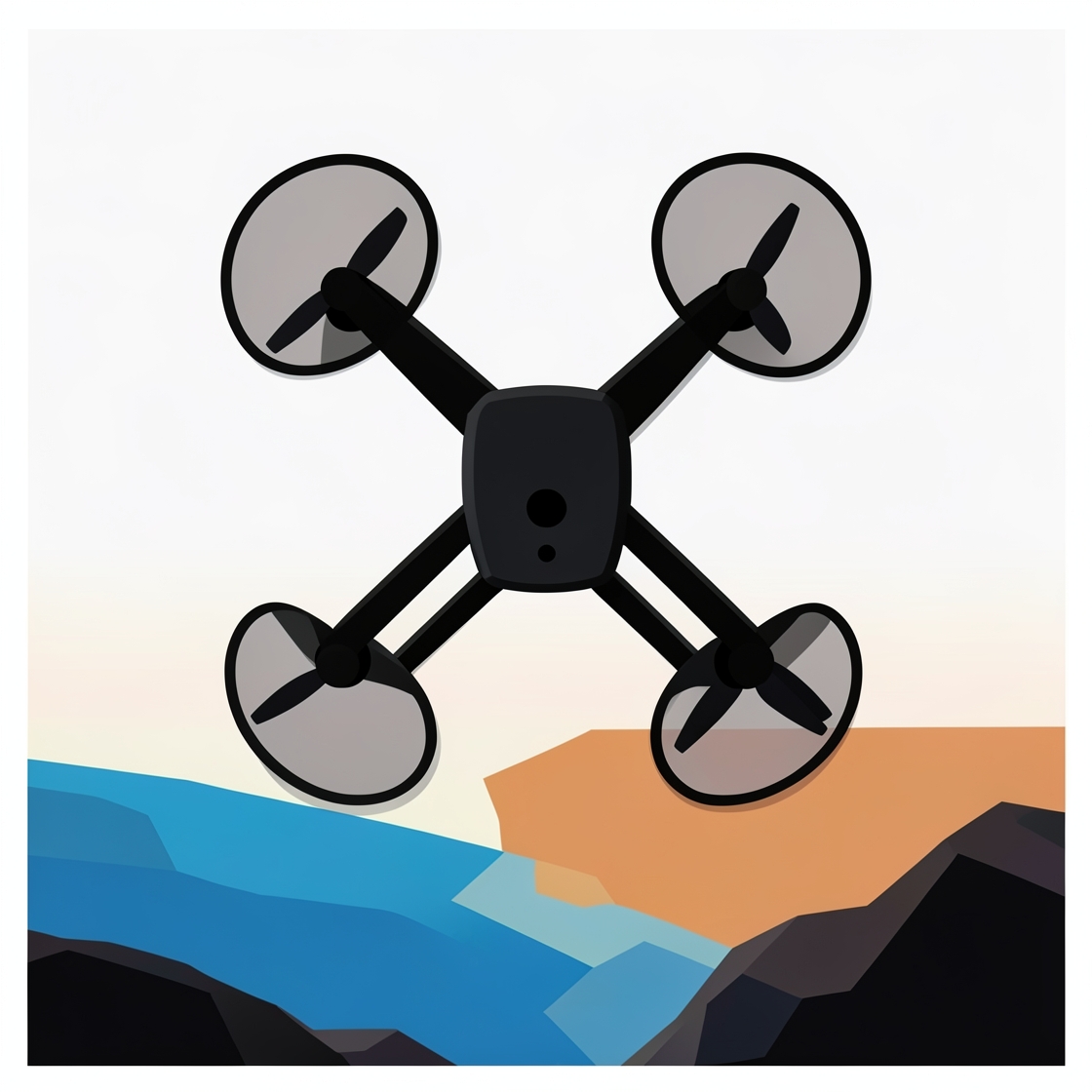
The most important accessory for a DJI Mini 5 Pro may be a precise scale. DJI describes the aircraft with its standard battery as 249.9g, only one tenth of a gram below a threshold that changes the treatment of small drones in many places. The same specification carries a manufacturing tolerance of plus or minus 4g. Before image quality enters the decision, the buyer needs to know what the flight-ready aircraft actually weighs and which rules apply at the place and date of flight.
That caveat does not erase the engineering achievement. A one-inch camera, a gimbal able to roll through 225 degrees and LiDAR-assisted obstacle sensing make the Mini 5 Pro a materially more capable imaging tool than the Mini 4 Pro. The central question is whether those gains improve the missions a buyer really flies, rather than whether DJI has assembled the longest specification list in the smallest shell.
This is a research-based review, not a hands-on test by TechKili. It synthesizes DJI documentation with attributed observations from TechRadar, Tom's Guide and WIRED. Manufacturer maximums are identified as claims, reviewer flight results are kept in their original context, and flight permissions should always be checked with the current aviation authority for the actual aircraft, battery, accessories and location.
The purchase begins with a scale, not a camera
The nominal figure is unusually consequential. DJI lists 249.9g with the standard Intelligent Flight Battery, but the published tolerance means an individual unit can land on either side of 250g. WIRED reported that its review aircraft was over that line. A propeller guard, identification label or other attachment can add more mass, and the Intelligent Flight Battery Plus deliberately trades low weight for much longer rated endurance.
That does not automatically make one configuration legal or illegal. Registration, remote identification, operating category, proximity to people and permitted airspace vary by country and can change over time. A European C0 marking, a United States registration rule and a United Kingdom operating requirement are not interchangeable. The reliable workflow is to weigh the complete takeoff configuration, identify its label and battery, then consult the current local authority before every unfamiliar mission.
| Flight configuration | DJI-rated endurance | Weight implication | Practical buying consequence |
|---|---|---|---|
| Standard battery | Up to 36 minutes | Nominally 249.9g, with stated ±4g manufacturing tolerance | Lightest official setup, but verify the individual aircraft and local rules |
| Intelligent Flight Battery Plus | Up to 52 minutes | Moves the aircraft clearly beyond the nominal sub-250g setup | More scheduling freedom, with additional weight and potentially different requirements |
| Standard battery with accessories | Depends on load and conditions | Guards, mounts and labels add to takeoff mass | Weigh the aircraft as it will actually fly, not as it arrived in the box |
The Mini 5 Pro's camera upgrade is easy to recommend; its regulatory advantage cannot be recommended from a model name alone.
A one-inch sensor changes when a mini drone is useful
The camera is the reason to accept that homework. DJI moves the Mini line to a one-inch CMOS sensor with 50MP still capture and an f/1.8 aperture. It records up to 4K/60 HDR for normal motion and 4K/120 for slow motion, with 10-bit H.265, D-Log M and HLG options for workflows that need more grading latitude. DJI claims as much as 14 stops of dynamic range, a manufacturer rating rather than an independently reproduced TechKili measurement.
Independent reports give the specification practical meaning. TechRadar considered it the best video quality it had seen in the sub-250g class and found the clearest improvement after the light falls, where smaller sensors become noisy or lose color. Tom's Guide likewise described low-light footage as detailed and vivid. For a travel creator, that moves the useful window beyond bright midday panoramas toward blue-hour city scenes, interiors viewed through openings and landscapes with a bright sky over darker ground.
The sensor does not make every frame automatic. Fifty-megapixel files reward good light and restrained processing; a 12.5MP mode can be more forgiving when pixels are combined. D-Log M preserves editing flexibility but requires an intentional color workflow. The fixed f/1.8 aperture also means exposure in video still depends on shutter speed, ISO and often neutral-density filters. A larger sensor raises the ceiling, yet the pilot still needs to manage motion blur and highlights.
There is only one physical camera. DJI offers digital reach, but a crop cannot reproduce the framing freedom or distant-subject quality of the Air 3S telephoto module. The Mini 5 Pro therefore improves the images a compact wide camera can make; it does not become a two-lens production drone.
The gimbal creates shots a second lens cannot
The unusual 225-degree roll range is more than a number for a product page. It lets the camera hold a level horizon at aggressive aircraft angles, roll deliberately for a stylized transition and point farther upward than a conventional mini-drone gimbal. Those movements can reveal a cliff face, building or tree canopy without forcing the aircraft into the same orientation as the camera.
True vertical capture is equally practical. Rotating the camera produces a native 9:16 frame instead of discarding the sides of a horizontal image, preserving more of the one-inch sensor for short-form video. The benefit is not that every flight should produce social clips. It is that one flight can capture horizontal footage for a long edit and vertical footage for a separate delivery without pretending a severe crop is equivalent.
This flexibility answers a different problem from adding a telephoto lens. A second focal length changes distance and perspective; the Mini 5 Pro gimbal changes orientation and movement. Creators who need both should look at a larger aircraft, but solo travelers who value unusual reveals and native vertical work gain more from this mechanism than a routine specification comparison suggests.
LiDAR helps, but responsibility stays with the pilot
DJI combines omnidirectional vision sensors with forward-facing LiDAR. The system is designed to recognize obstacles in more directions and improve route awareness in low light, while ActiveTrack 360 can keep a selected subject framed. The company also describes return-to-home behavior that can retrace a route without satellite positioning when the visual environment provides enough information.
Those are assistance systems, not permission to fly blind. Thin branches, wires, reflective surfaces, featureless walls, rain, darkness and rapidly moving objects can defeat optical sensing. A memorized path may also become unsafe after people, vehicles or doors move. The aircraft manual remains more important than a marketing animation because it states the conditions, warnings and control behavior behind each automated mode.
The useful gain is reduced workload. A pilot filming a cyclist or walking subject can devote more attention to composition when the aircraft has better spatial awareness, and LiDAR can improve confidence during a dim return. A preflight route, visual line of sight where required, a manual escape plan and an adequate landing reserve still determine whether that assistance remains recoverable when automation stops helping.
Thirty-six minutes is a ceiling, not a schedule
DJI's 36-minute standard-battery figure is measured under controlled conditions. Tom's Guide came close with roughly 35 minutes during a simple windless out-and-back flight. TechRadar saw about 20 minutes while recording 4K/60, using ActiveTrack and flying in moderate breeze. These results are not contradictory: they describe different missions, and the gap is exactly why a creator should plan from workload rather than from the number on the box.
Wind consumes energy on the outbound leg and can turn the return into the harder half of the trip. Tracking adds direction changes, high-frame-rate recording adds processing, and a responsible mission ends with reserve rather than at forced landing. For a repeatable shoot, twenty-something usable minutes from a standard pack is a safer planning assumption than scheduling 36 minutes of footage, while recognizing that a calm, simple route may run longer.
The Plus battery raises DJI's claim to 52 minutes, which can reduce interruptions and battery swaps. It also changes the weight decision discussed earlier. Longer endurance is valuable for mapping a route, waiting for light or repeating a take, but it is not a free upgrade if the heavier configuration changes registration or operating conditions where the buyer flies.
Storage is less dramatic but well judged. The 42GB internal capacity can save a flight when a card is forgotten, while microSD expansion remains necessary for regular 4K work. DJI's manual should be checked for supported capacity and speed; V30-or-faster media is the sensible baseline for high-bitrate modes. Internal storage is an emergency buffer, not a substitute for a card-and-backup routine.
Mini 4 Pro or Air 3S depends on the mission
The Mini 4 Pro remains relevant because its smaller 1/1.3-inch sensor is already capable in good light, its standard-battery packages are explicitly sold around 249g, and discounted bundles can include the controller and several batteries. Moving to Mini 5 Pro is most persuasive for dusk, high-contrast landscapes, 4K/120 work, the larger roll envelope and LiDAR-assisted sensing—not for someone whose flights end before sunset and whose current footage already meets the delivery.
The Air 3S pulls in the other direction. It offers better endurance and wind confidence plus a second camera for tighter framing. TechRadar's comparison also points to stronger performance in demanding conditions. The costs are a larger bag, more takeoff mass and the operating obligations attached to a heavier aircraft. It is a production choice for missions that matter more than minimum carry weight.
Choose Mini 4 Pro when daylight image quality, a complete lower-cost kit and the clearest standard 249g bundle matter more than the new sensor.
Choose Mini 5 Pro with the standard battery when low-light quality, creative gimbal movement and the lightest one-inch-camera setup are the priorities.
Choose Mini 5 Pro Plus batteries when fewer interruptions matter enough to accept higher takeoff weight and re-check the rules.
Choose Air 3S when wind, endurance and a telephoto view justify a heavier aircraft and a less compact travel system.
Build the kit around rules and shooting time
The base aircraft is the coherent purchase for a pilot who wants the new camera while keeping the lightest official configuration. A Fly More package can be better value than adding a controller, charger, spare propellers and batteries separately, but the words “Plus battery” must be treated as a configuration change rather than a harmless bundle upgrade. The exact contents also vary by market, so the retailer title and box list should be read before purchase.
Neutral-density filters are the most defensible image accessory for intentional video shutter speeds, followed by enough standard batteries for the planned route and a V30 microSD card from a reputable seller. Propeller guards can help in specific controlled training environments but add weight and are not a substitute for obstacle clearance. Every attachment should be included when the takeoff weight is checked.
There is no universal best kit. A city-break creator may prefer two standard packs and minimum luggage; a rural filmmaker waiting for sunset may accept a Plus pack after confirming the relevant requirements; an occasional daylight pilot may save substantially with Mini 4 Pro. Prices and stock change too quickly to preserve in this review, so the purchase links below identify verified product pages rather than asserting a lasting bargain.
Buying options and alternatives
Affiliate disclosure: As an Amazon Associate I earn from qualifying purchases. Links in this section may earn TechKili a commission without changing the purchase price.
DJI Mini 5 Pro with 1-inch CMOS camera: The opened Amazon listing matches the DJI Mini 5 Pro reviewed here and explicitly identifies the 1-inch CMOS camera, omnidirectional sensing, ActiveTrack 360 and 225-degree gimbal rotation.
DJI Mini 4 Pro Fly More Combo with DJI RC 2 and standard batteries: This verified Mini 4 Pro Fly More listing includes DJI RC 2 and three standard batteries while explicitly retaining the 249g configuration; it is the sensible lower-cost alternative when the larger Mini 5 Pro sensor is not essential.
DJI Mini 5 Pro Fly More Combo Plus with DJI RC 2: The verified Fly More Combo Plus adds DJI RC 2 and extended-life batteries for longer sessions, but those Plus batteries raise takeoff weight and can change the rules that apply; check the exact aircraft weight and local requirements before choosing it.

Sources, flight evidence and research boundaries
TechKili did not fly, weigh or record with this unit. The assessment is a research synthesis completed on 27 August 2026. Specifications and manufacturer claims were checked against DJI's product material and manual; flight time, image quality, wind behavior and sample-weight observations remain attributed to the reviewers who produced them. Tests conducted in different weather, modes and reserve policies should not be collapsed into a single “real-world” number.
The five direct sources used were:
DJI Mini 5 Pro official product page — camera, gimbal, sensing, weight and rated-flight specifications.
DJI Mini 5 Pro user manual — controls, safety conditions, storage, battery and automated-flight limitations.
TechRadar review — image quality, low-light, wind, tracking, flight time and Mini 4 Pro/Air 3S comparisons.
Tom's Guide review — multi-week flight, endurance and image-quality observations.
WIRED review — measured-sample weight, portability, camera, gimbal and coastal-wind observations.
Amazon links are included only after opening a product-detail page and matching its ASIN and listing identity. They do not prove stock, delivery eligibility or the best current price in every country. Flight rules are similarly dynamic: this review explains the purchase consequence of weight, but it is not legal or operational authorization.
Related Articles
USBSID-Pico connects vintage SID chips to USB, but the board revision matters
Hackaday's retrocomputing coverage highlights a bridge for real Commodore 64 sound chips. Voltage settings, controller choice and software support need a closer look.
Apple HomeView privacy depends on your paired device, too
A shared display's personal content requires face recognition and a recently unlocked paired device. Apple's Wi-Fi exception matters when setting household rules.
Harris HF-10 teardown shows how a clock tunes an analog filter
A newly identified 1985 chip links to the MF10 filter design. Its charge-transfer method explains clock-based tuning, while part identity alone cannot certify a replacement.
CMF Speaker S and M launch with USB-C audio and distinct stereo options
CMF's first speakers share wired audio and Auracast. Size, identical-model stereo pairing and conditional battery claims matter more than their removable panels.