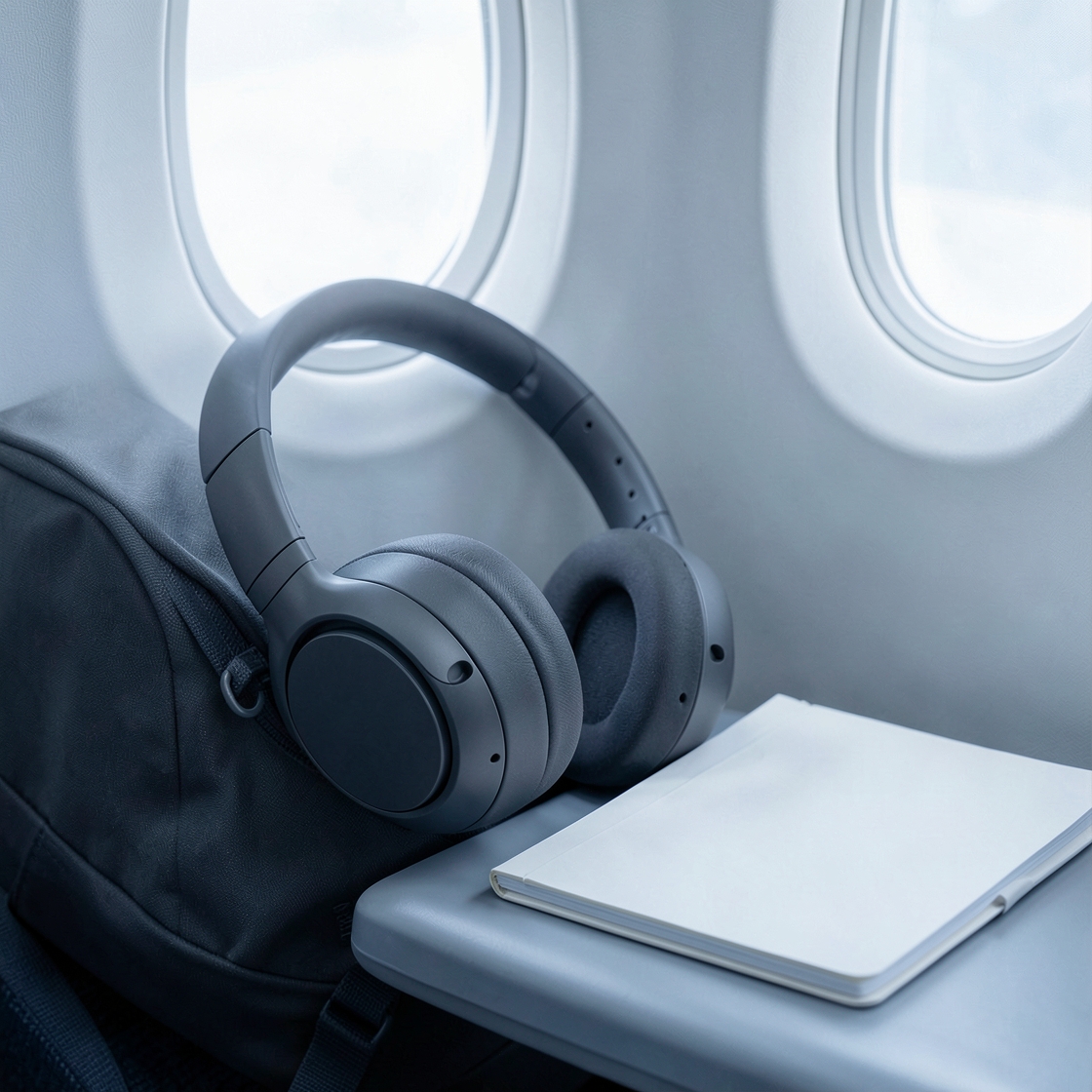
The Bose QuietComfort 2nd Gen is designed for the awkward hours between departure and arrival: the train before a flight, the open office before a call, or the long seatback movie after the cabin lights go down. Its most important improvements are not spectacular on a store page. They are a better seal around glasses, more padding, physical controls and two useful ways to listen through USB-C.
That makes this a travel tool before it is a showcase for spatial audio. Bose has brought Immersive Audio down from the Ultra line, but the evidence points toward quieter commutes and easier wired connections as the stronger reasons to buy. The central question is whether those practical changes justify replacing the 2023 QuietComfort or choosing this model over Sony's more feature-heavy WH-1000XM6.
This is a research-based review built from Bose's published specifications and testing by SoundGuys, Gizmodo and What Hi-Fi. TechKili did not physically test the headphones, so every measured or experiential finding below is attributed to the outlet that produced it.
QuietComfort 2nd Gen is built for the hours between places
Bose began shipping the QuietComfort Headphones (2nd Gen) on August 13, 2026. The launch position is revealing: it sits below the metal-accented QuietComfort Ultra but carries over several Ultra ideas, including TrueSpatial modes, ActiveSense in transparency mode and more adaptive noise cancellation. It is not the inexpensive Bose option; it is the comfort-first one for buyers who do not need every flagship feature.
The purchase case therefore depends on routine. A commuter may value buttons that work through gloves and a case that fits in a backpack. A traveler may care that the included cable connects directly to an aircraft's 3.5 mm socket. Someone working between a laptop and phone may care more about two-device multipoint than a long codec list. These details are less glamorous than a new driver, but they shape every day of ownership.
A 230 g design makes comfort the first specification
SoundGuys measured the headphones at 230 g and found the extended headband padding comfortable over long sessions. The earcups fold into the supplied case, and playback, volume and mode changes use physical buttons rather than the Ultra's touch strip. The same review also noted the tradeoff: the plastic structure can creak and does not feel as luxurious as the Ultra. There is no published IP rating, so this is not a rain or workout model.
The smooth, stepless headband replaces the previous generation's notched metal adjustment. That gives Bose more room for padding, but it is harder to return to an exact setting after sharing the headphones. Comfort is personal, yet the evidence is consistent that low mass, broad cushioning and modest clamp are the design's strongest qualities.
| Travel decision | QuietComfort 2nd Gen | Practical meaning |
|---|---|---|
| Weight | About 230 g | Less head and neck load during long sessions |
| Rated battery | Up to 24 h; 18 h with Immersive Audio | Enough for most trips, but not category-leading |
| Wireless | Bluetooth 5.4, SBC/AAC, two-device multipoint | Easy device switching; no advanced Bluetooth codec |
| Wired paths | USB-C digital and included USB-C-to-3.5 mm cable | Works with laptops and airline seat systems |
| Controls | Physical buttons | Predictable operation without looking at an app |
| Weather protection | No published IP rating | Keep them away from rain and sweaty training sessions |
The seal matters more than the spatial modes
Bose says its six-microphone system now compensates better when glasses, hair or a hat breaks the earcup seal. Gizmodo wore the headphones with sunglasses and found the improvement credible, while SoundGuys measured 85.1% average perceived loudness reduction with ANC active under its own protocol. Those are different forms of evidence, but together they support the same practical conclusion: the regular QC remains a serious noise-cancelling headphone even without Ultra branding.
Aware mode lets outside sound back in, and ActiveSense momentarily applies cancellation to sudden spikes. Gizmodo found that useful against subway screech, although its transparency still trailed AirPods Max 2. SoundGuys identified a different weakness: wind remained distracting in Aware mode. Buyers who walk beside traffic should audition that mode rather than assuming transparency performance matches ANC performance.
Immersive Audio offers Still, Motion and Cinema modes. Both independent reviews treated it as secondary. SoundGuys spent most listening time in normal stereo, while Gizmodo found the spatial effect pleasant but forgettable. Cinema mode may help dialogue feel centered on a laptop, yet it reduces Bose's rated battery from 24 to 18 hours.
The buying rule is simple: choose these headphones for seal-tolerant quiet and comfort; treat spatial audio as an optional extra, not the reason to upgrade.
USB-C solves two travel problems at once
The old dedicated 3.5 mm socket is gone, but Bose includes two cables. USB-C to USB-C carries digital audio from a compatible computer or phone at up to 24-bit/48 kHz. The USB-C-to-3.5 mm cable accepts an analog source such as an airline entertainment system. SoundGuys called that combination one of the most useful upgrades because it avoids a separate dongle while preserving legacy access.
Lossless input does not guarantee audible superiority in every environment, especially on a noisy aircraft, and it should not be confused with high-resolution Bluetooth. Wireless playback remains SBC or AAC. The value is flexibility: one port charges, carries digital audio and accepts analog audio through the supplied cable.
Battery and calls reveal the mid-tier compromises
Bose rates the battery at 24 hours with normal ANC listening. That covers a workday and most long-haul flights, but Sony rates the WH-1000XM6 at 30 hours and the Bose Ultra can run longer in some modes. SoundGuys had not completed its standardized battery run when its review was published, so Bose's number should be treated as a manufacturer rating rather than an independent result.
Call performance is the sharper warning. Bose says background-noise filtering is improved, but Gizmodo's street and office call produced heavy ambient pickup and unstable ANC behavior; its conversation partner rated the experience poorly. SoundGuys also identified wind as a problem in Aware mode. People who take important calls outdoors should not assume the six-microphone count translates into flagship voice isolation.
There are smaller constraints too. The app offers only three-band bass, mid and treble adjustment. SoundGuys liked the default balance with a little extra bass, while Gizmodo heard the low end overwhelm parts of some mixes at lower volume. That disagreement is a reason to use a return window or in-store audition, not proof that either account is wrong.
Keep the old QC, choose Sony, or step up to Ultra
Owners of the 2023 QuietComfort should upgrade selectively. The second generation adds USB-C audio, spatial modes, more padding and seal-gap compensation, but it does not transform battery life or material quality. If the older pair fits well and already cancels noise effectively, a cable or cosmetic refresh is not enough reason to replace working headphones.
Sony's WH-1000XM6 is the stronger alternative for buyers who want a longer 30-hour rating, a deep app EQ and advanced Bluetooth options. It is also a close competitor on ANC. Bose counters with lower weight, straightforward buttons and an unusually complete wired travel kit. The decision is about priorities, not one universally superior pair.
The QuietComfort Ultra (2nd Gen) adds more premium construction, aptX Adaptive, a touch volume strip and a longer rated battery, but it costs more and weighs more. SoundGuys concluded that many shoppers should save money with the regular QC because ANC and comfort are already close to the flagship experience.
Choose around the trip you actually take
Buy the QuietComfort 2nd Gen when the following priorities describe your routine:
You wear glasses and need ANC that remains effective with an imperfect seal.
You spend hours in headphones and value 230 g weight, broad padding and physical controls.
You regularly switch between a phone and laptop through multipoint.
You need both digital USB audio and a cable for aircraft or older 3.5 mm sources.
Choose another model if outdoor calls, rain protection, the longest possible battery, elaborate EQ or advanced wireless codecs matter more. Existing QuietComfort owners should keep their pair unless USB-C audio or fit compensation solves a specific frustration. Sony is the more configurable rival; Bose Ultra is the more luxurious one.
The second-generation QuietComfort succeeds because it respects ordinary use. It does not win every specification, and its spatial features do not redefine listening. It does make quiet, comfort and connection unusually easy, which is precisely what a travel headphone should do.
Buying options and alternatives
Affiliate disclosure: As an Amazon Associate I earn from qualifying purchases. Links in this section may earn TechKili a commission without changing the purchase price.
Sony WH-1000XM6 Wireless Noise Cancelling Headphones (Black): A close premium ANC alternative for buyers who value longer rated battery life, a deeper app EQ, and advanced Bluetooth features.
Twelve South AirFly Pro Bluetooth Audio Transmitter (White): A compact companion that sends audio from airplane seat screens and other 3.5 mm sources to Bluetooth headphones.

Evidence, sources and research boundaries
This synthesis separates Bose's claims from independent observations. SoundGuys supplied the attenuation result, weight, comfort, control and wind findings. Gizmodo supplied the glasses, subway, sound and call observations. What Hi-Fi supplied feature comparisons with the Ultra and broader competitors. Prices and availability can change; no live Amazon price, rating or stock claim is included.
Sources: Bose product specifications; Bose launch announcement; SoundGuys review and measurements; Gizmodo review; What Hi-Fi comparison.
Related Articles
Eiliko security report: guest Wi-Fi cannot repair cloud access controls
Newly disclosed research concerns stored conversations and control of robot responses. Local network isolation addresses only part of that architecture.
Bee Eclipse and Frontier separate audio deletion from data sharing
Amazon pairs new conversation-memory hardware with Alexa+ and shopping integrations. The useful decision is what to capture, retain and share.
USBSID-Pico connects vintage SID chips to USB, but the board revision matters
Hackaday's retrocomputing coverage highlights a bridge for real Commodore 64 sound chips. Voltage settings, controller choice and software support need a closer look.
Apple HomeView privacy depends on your paired device, too
A shared display's personal content requires face recognition and a recently unlocked paired device. Apple's Wi-Fi exception matters when setting household rules.